TL;DR:
- Fidgeting supports self-regulation, reduces anxiety, and helps children with neurodiverse conditions stay attentive. UK NHS guidance and recent studies show that matching fidgets to sensory needs enhances their benefits. Using appropriate tools at home, school, and parties promotes better focus and emotional regulation for these children.
Yes, fidgeting genuinely helps many neurodiverse children — and UK clinical guidance backs that up. Buckinghamshire Healthcare NHS Trust explicitly supports allowing movement as a self-regulation strategy, noting it helps some children stay at an alert level for learning. Research adds weight to that: a 2023 study in Current Psychology found parents of autistic children were significantly more likely to report that fidget tools reduce anxiety, and the UC Davis MIND Institute summarised evidence showing intrinsic fidgeting supports sustained attention in children with ADHD. The main benefits parents report are:
- Reduced anxiety during transitions and busy environments
- Better sustained attention, especially as tasks continue
- Improved self-regulation and arousal modulation
- Sensory processing support for tactile, proprioceptive and vestibular needs
From the research: In the Current Psychology 2023 study, 32% of parents of autistic children said fidget tools reduce anxiety, with a further 30% saying “definitely yes” — compared with 13% and 9% respectively among parents of neurotypical children.
Table of Contents
- What is fidgeting, and why does it help?
- What does the research say about fidgeting benefits?
- How do you match a fidget to your child’s sensory profile?
- Using fidgets at home, in school and at SEN-friendly parties
- Safety, boundaries and signs a fidget is not helping
- Quick scripts: what to say to teachers, other parents and party hosts
- Key takeaways
- Why I stopped asking my son to sit still
- Sensory sessions and SEN-friendly parties in Brighton & Hove
- Useful sources and further reading
- FAQ
What is fidgeting, and why does it help?
Picture a child doodling in the margins while listening to a story. Or rocking gently on a chair. Or working a piece of blu-tac between their fingers. That is intrinsic fidgeting: spontaneous, self-generated movement the body uses to stay regulated. It is different from deliberately handing a child a fidget tool, though both draw on the same underlying mechanism.
The body has sensory systems beyond sight and hearing. Proprioception tells you where your body is in space; the vestibular system handles balance and movement; the tactile system processes touch and texture. For many neurodiverse children, these systems need more input than a typical classroom or living room provides. When that input is missing, the nervous system struggles to stay at the right level of alertness for the task at hand. Movement fills the gap.
The UC Davis MIND Institute found that intrinsic fidgeting tends to increase as a task continues, which suggests it is the body’s own strategy for preventing attention from dropping off. That is worth sitting with. The fidgeting is not the problem; it is the solution the child has already found.
- Doodling supplies low-level proprioceptive and tactile input without demanding visual attention
- Rocking activates the vestibular system and can lower arousal in an overstimulating space
- Fiddling with blu-tac or a resistance item provides deep-pressure proprioceptive feedback
Pro Tip: If your child already fidgets in a particular way, that is useful information. It tells you which sensory system they are trying to feed. Start there when choosing a tool.
What does the research say about fidgeting benefits?
The evidence is clearest when studies focus on neurodiverse children and match the fidget to the child’s sensory profile. Here is what the research currently supports:
- Anxiety reduction. Parents of autistic children report significantly higher rates of anxiety reduction from fidget tools than parents of neurotypical children. The difference is substantial, not marginal.
- Sustained attention. A Frontiers in Psychiatry quantitative analysis found more fidgeting during correct trials on a cognitive task, supporting the theory that fidgeting aids arousal and sustained attention in ADHD.
- Self-regulation and arousal modulation. Occupational therapy models, referenced in the Educational Psychology Review 2024, frame stimming and fidgeting as the body seeking an optimal level of sensory stimulation. It is regulation, not misbehaviour.
- Sensory processing support. The BCUHB neurodevelopmental sensory booklet recommends handheld tactile items and movement breaks to support attention in children with sensory processing differences.
- Reframing stimming as a thinking tool. The Educational Psychology Review 2024 goes further, arguing that stimming functions as an epistemic resource: something that supports thinking and learning, not something to be suppressed.
One important caveat: evidence reviews note that positive effects are more likely when the fidget matches the child’s sensory needs. A spinner handed to a child who needs deep pressure may do nothing at all.
| Benefit | Sensory system | Example fidget type |
|---|---|---|
| Anxiety reduction | Tactile / proprioceptive | Squishy resistance ball, textured putty |
| Sustained attention | Proprioceptive / vestibular | Wobble cushion, resistance band on chair |
| Self-regulation | Vestibular | Rocking chair, balance board |
| Sensory processing | Oral / tactile | Chewable pendant, smooth stone |
| Emotional regulation | Deep pressure | Weighted lap pad, compression sleeve |

How do you match a fidget to your child’s sensory profile?
Remy used to chew the cuffs of every jumper he owned. I went through a lot of jumpers before I understood that his mouth was telling me something: he needed oral proprioceptive input to stay regulated. Once I knew that, choosing a tool became much simpler.
A three-step trial works well for most families:
- Observe. Watch what your child already does when they are concentrating or anxious. Chewing, rocking, hand-flapping, sleeve-pulling — each points to a sensory system.
- Try. Offer one item at a time for a 5–10 minute mini-trial during a low-stakes activity. Note what changes: does the child seem calmer, more focused, less distressed?
- Rate. Keep a brief note (a voice memo is fine) of what helped, what made things worse, and what the child reached for again.
The Current Psychology 2023 study confirms that matching the fidget to the child’s sensory-seeking profile is key. One size genuinely does not fit all.
| Sensory profile | Safe item attributes | Trial tip |
|---|---|---|
| Tactile seeker | Varied textures, washable, no loose parts | Try during story time or a meal |
| Proprioceptive seeker | Resistance, weight, squeeze-able | Use during desk tasks or transitions |
| Vestibular seeker | Rocking, spinning, movement-based | Offer a wobble cushion at the table |
| Oral seeker | Food-grade silicone, age-appropriate size | Introduce as a pendant or bracelet |
| Deep pressure | Weighted, snug-fitting | Try a lap pad during screen time |
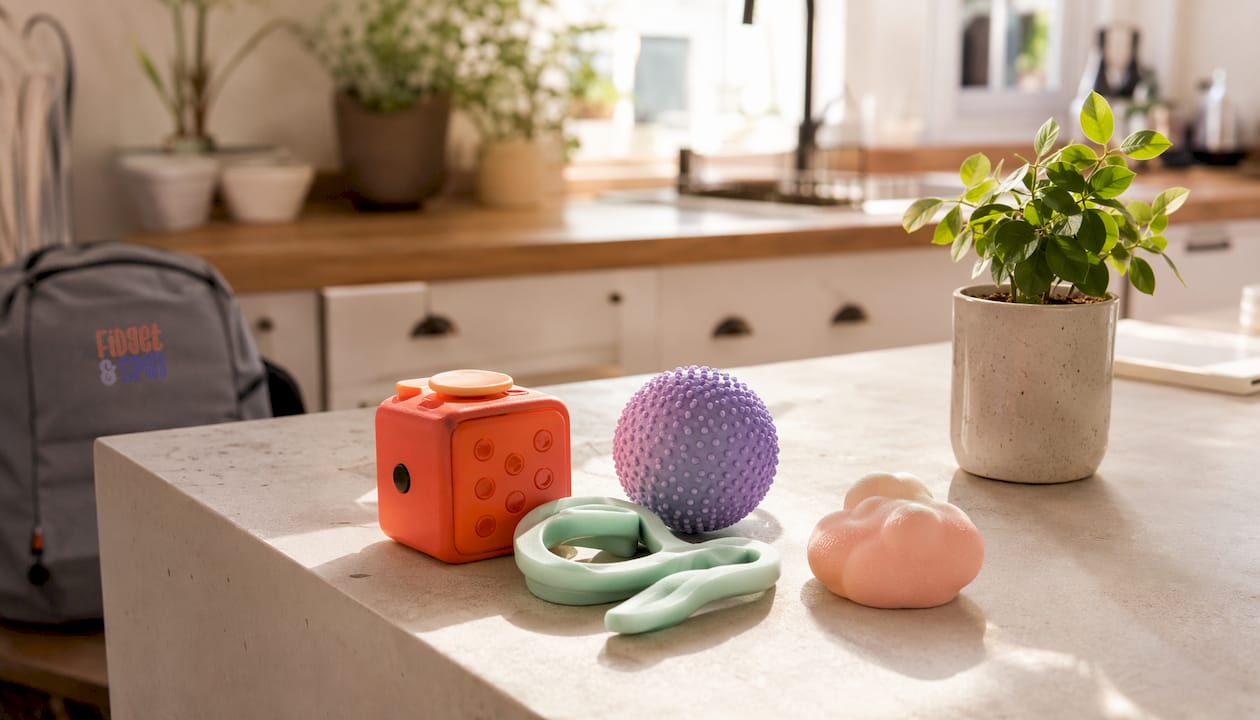
Pro Tip: Build a small sensory toolkit rather than hunting for one magic toy. Three or four items covering different systems lets your child choose what fits their current state.
Using fidgets at home, in school and at SEN-friendly parties
At Remy’s fifth birthday party, we put a small basket of fidget items on every table. One child spent the entire party working a piece of textured putty and barely looked up — but he stayed, he was calm, and his mum cried a little at the end. That basket cost about £8.
At home:
- Keep a small toolkit accessible, not locked away as a reward
- Allow movement during homework: a wobble cushion or standing desk works well
- Use sensory regulation activities as part of a wind-down routine
At school:
- Share the child’s sensory profile with the SENCO in writing before term starts
- NHS Greater Glasgow & Clyde guidance supports classroom movement and fidget options, which gives parents a citable reference when requesting adjustments
- Ask for a movement break every 20–30 minutes, not as a privilege but as a regulation strategy
At a SEN-friendly party:
| Element | What to set up |
|---|---|
| Quiet zone | One corner with low lighting, cushions, ear defenders available |
| Fidget station | Small basket of tactile items on each table |
| Space layout | Clear routes between zones, no bottlenecks |
| Transitions | Five-minute verbal warning before each activity change |
Script for a party host: “My child uses a fidget item to stay regulated. Could we keep a small basket on the table? It helps them stay present and enjoy the party.”
Safety, boundaries and signs a fidget is not helping
At a soft-play session once, I watched another parent hand her three-year-old a fidget spinner with small detachable parts. My stomach dropped. Age-appropriate safety matters.
Safety rules:
- Check for choking hazards: no loose parts for children under three, and supervise closely under five
- Consider noise: a loud clicker in a classroom or quiet party space can distress other children
- Check school policy before sending a fidget in — some schools have guidelines
- Wash tactile items regularly, especially shared ones
- Avoid items that light up or make sounds if your child is easily over-stimulated
Red flags that a fidget is not helping:
- The child becomes more distracted or fixated on the toy rather than the task
- Anxiety increases rather than decreases
- The child uses it to avoid interaction entirely rather than to stay present within it
- Other children are distracted or upset by it
If a fidget consistently makes things harder, swap it rather than persisting. The real impact of fidget toys varies by child and context.
Where to get UK support: your child’s SENCO, your GP, or a referral to a local NHS occupational therapy team. The Buckinghamshire Healthcare NHS Trust ‘Fidgeting is OK’ leaflet is a good starting point to share with school.
Pro Tip: If a fidget is causing more problems than it solves, that is not a failure. It is data. Try a different sensory system.
Quick scripts: what to say to teachers, other parents and party hosts
I once spent ten minutes at a school gate trying to explain why Remy needed to keep his putty during carpet time. The teacher looked politely baffled. I wish I had had a one-liner ready.
- To a teacher: “Remy’s occupational therapist recommends a handheld fidget during listening tasks. It helps him regulate and stay focused. Could we trial it for two weeks and review?”
- To another parent: “He uses a fidget to help him concentrate — same idea as doodling. It’s not a distraction for him; it’s how he listens.”
- To a party host: “Could we have a quieter corner available? He might need five minutes away from the noise. He’ll be fine — he just needs the option.”
Framing adjustments as equitable rather than exceptional tends to land better. “Good listening looks different for everyone” is a phrase used in NHS GGC school guidance and it is genuinely useful to borrow.
Pro Tip: Offer something in return when making a request: “I’m happy to send in a written summary of what works, so it’s easy to pass on to supply teachers.”
Key takeaways
The benefits of fidgeting for neurodiverse children are backed by UK NHS guidance and peer-reviewed research, and the most important step is matching the fidget to your child’s specific sensory profile.
- Observe first. Watch what your child already does to self-regulate — that tells you which sensory system to target.
- Trial one item at a time for 5–10 minutes during a low-stakes activity, and note what changes.
- Communicate clearly with school, hosts and other carers using a short, factual script.
If things are not improving, contact your SENCO or ask your GP for an occupational therapy referral. NHS guidance from Buckinghamshire Healthcare Trust and NHS Greater Glasgow & Clyde are both worth sharing with school. And keep trialling: one fidget rarely fits every situation or every mood.
| Point | Details |
|---|---|
| Anxiety reduction evidence | Parents of autistic children reported “yes” (32%) and “definitely yes” (30%) for anxiety reduction in the Current Psychology 2023 study. |
| Sustained attention | Intrinsic fidgeting increases as tasks continue, suggesting it is the body’s own strategy to prevent attention dropping off. |
| Sensory profile matching | Matching the fidget to the child’s sensory-seeking profile is the single biggest factor in whether it helps. |
| Safety first | Check for choking hazards, noise impact, and school policy before introducing any fidget tool. |
| Fidget and Spin sessions | Fidget and Spin’s weekly sensory sessions in Brighton & Hove offer three sensory zones where children can trial movement, tactile and low-stim options in a supported setting. |
Why I stopped asking my son to sit still
There was a toddler group we used to leave early. Every single week. Remy would start rocking, or flapping, or spinning in circles, and I would feel the room shift. Not hostile, exactly. Just that particular kind of silence. I would gather our things and we would go.
For a long time I thought the problem was the rocking. So I tried to stop it. Gently, then firmly, then with a sinking feeling that I was making things worse. He would go rigid, lose the thread of whatever he had been doing, and melt down ten minutes later. The suppression was costing him something. The Educational Psychology Review 2024 puts it plainly: forcing a child to mask movement uses up cognitive resources that could go towards the actual task. I did not have the research then. I just had a miserable Tuesday morning.
What changed things was a parent’s guide to fidget tools that reframed the rocking not as a behaviour to fix but as information. His body was telling him something. Once Anthony and I started listening to it rather than suppressing it, we built a small toolkit with visual tools for therapy sessions: a wobble cushion, a piece of textured putty, a chewable pendant. Not every item worked every time. But the meltdowns after carpet time dropped off noticeably.
The Fidget and Spin sessions came later, and they gave Remy somewhere to move without anyone flinching. Three sensory zones, children who get it, parents who get it. Small wins, honestly. But they add up.
If you are still in the leaving-early phase, I see you. It does get more manageable. Not because your child changes, but because you get better at reading what they need.
Sensory sessions and SEN-friendly parties in Brighton & Hove
If you want to try fidgets and sensory play in a setting that is already set up for it, Fidget and Spin runs weekly stay-and-play sessions for neurodiverse children aged 1–6 across three sensory zones: Wiggle & Bounce for big movement, Squish & Squeeze for tactile play and fidgets, and Snuggle & Chill for low-stim downtime. No side-eye. No leaving early.
For birthdays, the SEN-friendly party packages cover ages 1–7 across Brighton, Hove and wider Sussex, with three options from £220. Every setup includes a quiet zone, flexible transitions and a fidget station as standard. If cost is a barrier, Pay-It-Forward concession spots are available at checkout. You can also book a weekly session to try the space before committing to a party. Both options are bookable online.
Useful sources and further reading
- Fidgeting is OK — Buckinghamshire Healthcare NHS Trust — UK clinical leaflet explaining why movement supports alertness and learning; good to share with school.
- Sensory processing resources — NHS Greater Glasgow & Clyde — UK NHS classroom strategies and movement guidance; useful for SENCO conversations.
- Neurodevelopmental sensory booklet — BCUHB (Wales) — UK NHS Wales practical item recommendations and movement break strategies.
- Are fidget toys beneficial? — Current Psychology (2023) — Peer-reviewed study with parent-reported data on anxiety reduction; strongest evidence for autistic children.
- Does fidgeting help people with ADHD focus? — UC Davis MIND Institute (2024) — US-based research summary on intrinsic fidgeting and sustained attention in ADHD. (Non-UK source.)
- Stimming as thinking — Educational Psychology Review (2024) — Academic paper reframing stimming as an epistemic and regulatory resource; useful for educators.
- Fidgeting for focus: what actually works for neurodiverse kids — Fidget and Spin — Practical strategies and study summaries from a Brighton SEN perspective.
- Effects of fidgeting: what every SEN parent should know — Fidget and Spin — How fidgeting provides sensory input and how it is used in therapeutic practice.
FAQ
Does fidgeting actually help neurodiverse children focus?
Yes, particularly for children with ADHD and autism. The UC Davis MIND Institute summarises research showing intrinsic fidgeting supports sustained attention, and the effect tends to increase as a task continues.
What do UK NHS guidelines say about fidgeting in children?
Buckinghamshire Healthcare NHS Trust explicitly states that fidgeting helps some children remain at an alert level for learning, and NHS Greater Glasgow & Clyde school guidance recommends offering movement and fidget options in the classroom.
How do I know which fidget toy is right for my child?
Observe what your child already does to self-regulate — rocking, chewing, or squeezing each points to a different sensory system. The Current Psychology 2023 study confirms that matching the fidget to the child’s sensory-seeking profile is the key factor in whether it helps.
Can fidget toys make anxiety worse?
They can, if the wrong type is chosen or if the child becomes fixated on the toy rather than using it to regulate. Watch for increased distraction or escalating anxiety and swap to a different sensory system if that happens.
Where can I find SEN-friendly sensory play in Brighton?
Fidget and Spin runs weekly sensory sessions for neurodiverse children aged 1–6 and SEN-friendly birthday parties for ages 1–7 across Brighton, Hove and Sussex, with three sensory zones designed around movement, tactile play and low-stim rest.
Recommended
- What are fidget toys? A parent’s guide for neurodiverse kids | Fidget and Spin Brighton
- Benefits of fidget toys for neurodiverse children | Fidget and Spin Brighton
- Effects of fidgeting: what every SEN parent should know | Fidget and Spin Brighton
- Fidgeting for focus: what actually works for neurodiverse kids | Fidget and Spin Brighton