
TL;DR:
- A birthday party for a non-verbal child should focus on sensory safety and familiar communication tools to ensure inclusion. Small guest groups, controlled environments, and strategic use of visual supports help reduce anxiety and promote genuine enjoyment. Prioritizing the child’s comfort over spectacle leads to more meaningful celebrations tailored to their needs.
A birthday party for a non-verbal child is a carefully designed celebration that adapts the environment, communication tools, and activities to match the child’s sensory and social needs. More than half of autistic children experience exclusion from peer activities, which makes thoughtful party planning one of the most meaningful things you can do. The good news is that with some preparation, a genuinely joyful and inclusive birthday celebration is absolutely possible. Tools like PECS, visual schedules, and designated chill-out zones are not extras. They are the foundation.
What makes a birthday party work for a non-verbal child?
The biggest shift in thinking is this: you are not scaling down a mainstream party. You are building something different from scratch. A sensory birthday party puts regulation first and spectacle second. That means choosing the environment before you choose the theme, and planning communication before you plan the cake.
Non-verbal children, including many autistic and SEND children, often rely on augmentative and alternative communication (AAC) systems such as PECS (Picture Exchange Communication System) or simple choice boards. These are the recognised tools in this space, and they matter at parties just as much as they do at home or school. The novelty of a party, the noise, the people, the change in routine, all of it stacks up fast. A plan that accounts for that is not overprotective. It is just good hosting.
How should you choose the venue and set up the sensory environment?
The venue is the single most important decision you will make. A loud, bright, unfamiliar space will work against you before the first guest arrives.
The best options for a sensory-friendly party are:
- Home, where the child already knows the layout, smells, and sounds
- Sensory gyms or soft play spaces designed for SEN children, where equipment and lighting are already adapted
- Quiet outdoor spaces like a familiar park or garden, where children can move freely and escape noise naturally
Once you have the venue, look at the sensory details. Swap harsh overhead lighting for lamps or fairy lights. Avoid foil balloons, which crinkle and pop unpredictably. Keep music low or instrumental, and have a clear off switch. Decorations do not need to be minimal, but they should avoid flashing lights or anything that moves unexpectedly.
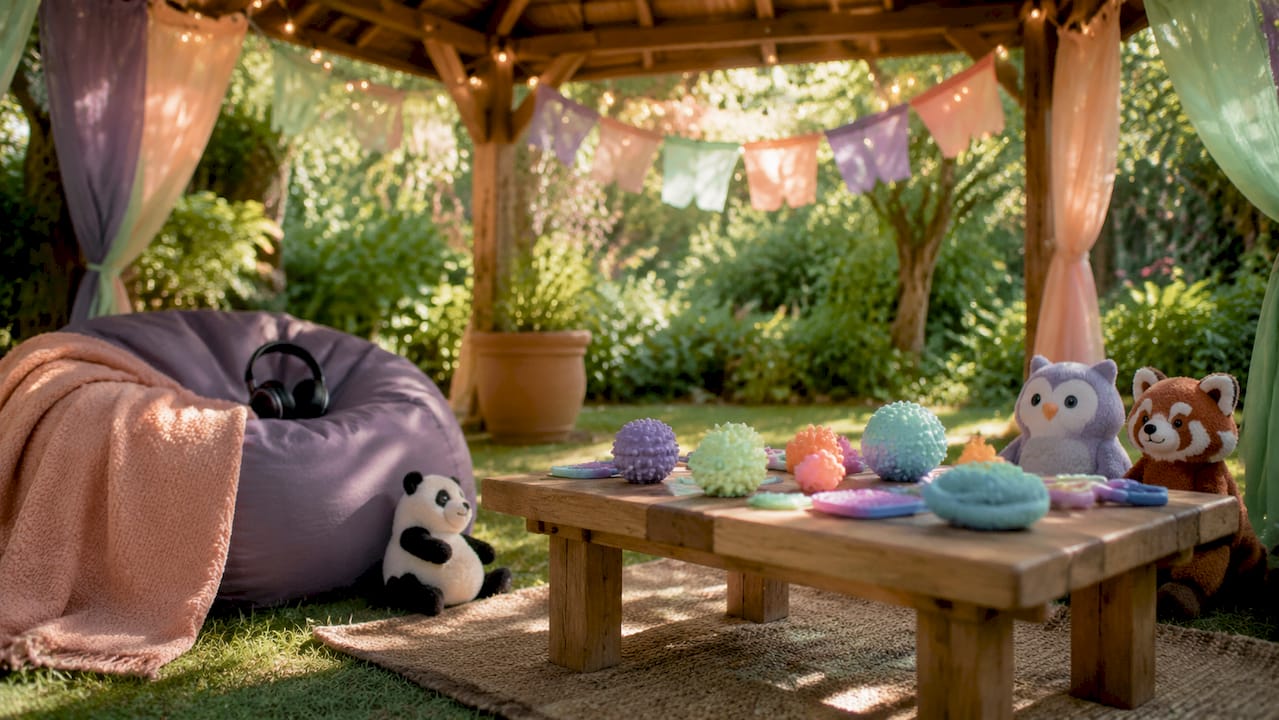
A permanent chill-out zone with bean bags, noise-cancelling headphones, and fidget toys gives children a self-regulation space without having to leave the party entirely. Occupational therapists recommend this as a fixed feature, not a last resort. Set it up in a corner that is visible from the main space but slightly separated. Make it inviting, not clinical. A favourite blanket, a weighted lap pad, a few familiar objects. The child should be able to drift in and out without it feeling like a time-out.
Pro Tip: Visit the venue with your child a few days before the party. Walk the space together, show them where the chill-out zone will be, and let them explore without any party pressure. Familiarity is one of the most effective anxiety-reducers there is.
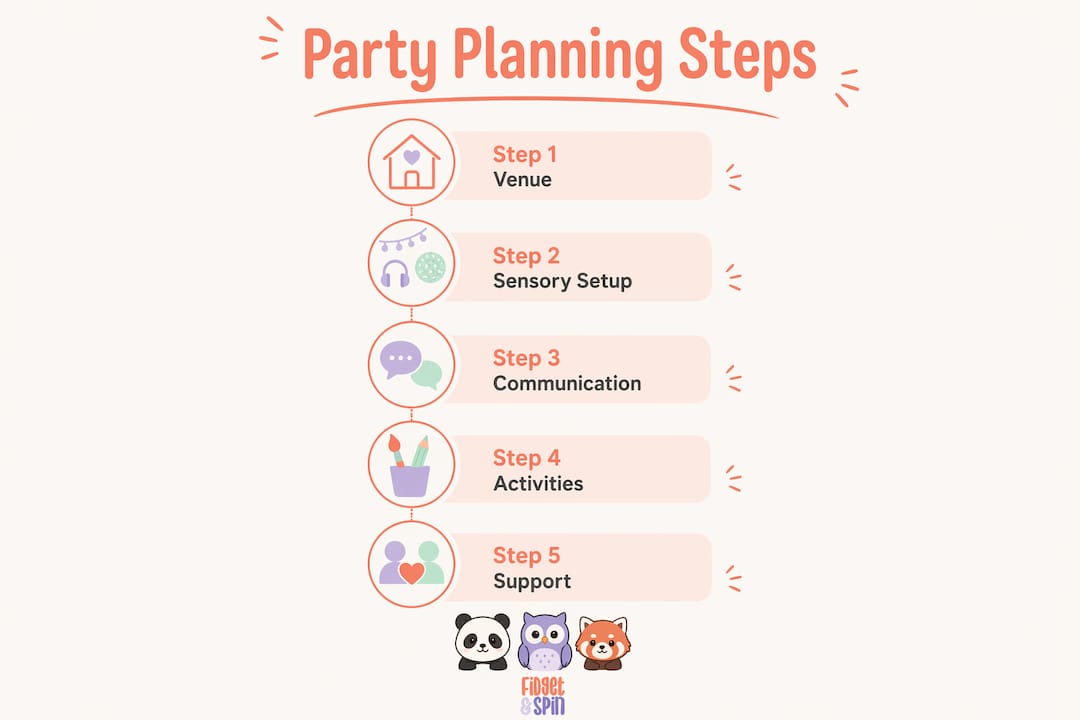
How can visual supports and communication tools help at the party?
PECS and visual choice boards allow non-verbal children to communicate key needs during events, including “more,” “stop,” “help,” and “break.” These tools reduce frustration and give children genuine autonomy over their experience. Print them out, laminate them if you can, and keep them accessible throughout the party, not tucked away in a bag.
A visual schedule is equally powerful. Create a simple picture-based sequence showing each part of the party: arriving, playing, singing, cake, presents, goodbye. Go through it with your child multiple times in the days before. Rehearsing a visual schedule reduces anxiety by shrinking the novelty of the event. The party stops being an unknown and starts being something they have already seen.
Here is what to include in your communication toolkit:
- A printed visual schedule displayed at child height throughout the party
- A PECS board or AAC device within easy reach at all times
- Simple choice boards for food, activities, and sensory preferences
- A “finished” card or symbol to signal when an activity is ending
- A quiet signal or gesture agreed in advance for when the child needs a break
Pro Tip: Send a brief note to guests before the party explaining how your child communicates. Ask them to follow the child’s lead, avoid demanding eye contact, and accept gestures or object-offering as genuine communication. Most people want to get it right. They just need to know how.
Which activities work best for engaging a non-verbal child and their guests?
Simple, repetitive face-to-face games build social connection far more effectively for non-verbal children than structured group games. Think tickling games, peek-a-boo, bouncing on a trampoline together, or rolling a ball back and forth. These are not babyish. They are the kinds of gentle social interactions that feel safe, predictable, and genuinely fun.
Activity blocks of 20–30 minutes followed by 5–10 minutes of low-stimulation free time prevent sensory overload from building. That rhythm gives children a chance to reset before the next activity begins. It also means no single activity has to carry the whole party.
| Activity type | Examples | Sensory level |
|---|---|---|
| High stimulation | Musical statues, party poppers, group dancing | High noise, unpredictable movement |
| Medium stimulation | Bubble play, parachute games, simple ball games | Moderate, mostly predictable |
| Low stimulation | LEGO building, sensory trays, playdough, quiet crafts | Calm, self-directed, tactile |
| People games | Tickling, peek-a-boo, bouncing, rolling a ball | Repetitive, face-to-face, low noise |
Voluntary participation is non-negotiable. Watching from the side is a completely valid way to take part. Observing a child’s subtle cues is how you measure success, not whether they joined in every activity. A child who sat near the bubble machine and smiled is having a good party. You can find more ideas for inclusive group activities that work well for SEN children of different ages and needs.
How do you manage the high-stress moments and transitions?
Arrival is stressful. The birthday song is stressful. Prize-giving is stressful. These are the three moments that most often tip a party from manageable to overwhelming, and they are almost never planned for.
Here is a practical approach to each one:
- Arrival: Greet guests in small groups rather than all at once. Have a low-key activity already running so the child can join in rather than stand at the door being looked at.
- The birthday song: The “Happy Birthday” song is a frequent trigger for meltdowns due to its sudden volume and group nature. Offer noise-cancelling headphones during the song, use a quiet countdown instead, or light the candles without any singing at all. The cake still gets eaten. Everyone still claps. It works.
- Prize-giving or pass-the-parcel: Keep these optional. Unwrapping in front of a group is genuinely hard for many children. Let your child open gifts privately after guests leave if that feels better.
- Every transition: Use a visual countdown, a simple “five more minutes” card, or a consistent phrase your child recognises. Visual schedules with planned quiet breaks every 20–30 minutes prevent the build-up of sensory fatigue that turns a good party into a hard one.
Pro Tip: Assign one trusted adult, a grandparent, a close friend, to be the child’s dedicated support person throughout the party. That person’s only job is to follow the child’s lead, offer the chill-out zone when needed, and run interference if a moment gets too big. It takes the pressure off you to be everywhere at once.
What practical steps help you prepare everyone for the day?
The week before the party matters as much as the day itself. Preparation is where most of the anxiety-reduction actually happens.
- Keep the guest list to 4–6 close friends or family members. A small guest list creates a genuinely manageable environment for sensory-sensitive children, and it means every person there already knows and cares about your child.
- Talk through the party plan with your child repeatedly in the days before. Use the visual schedule as a prop. Make it familiar.
- Let your child know they can take a break at any point, without explanation and without it being a big deal.
- Tell guests in advance about sensory needs, communication preferences, and what to do if the child seems overwhelmed.
- Avoid the common mistake of over-scheduling. Two or three activities is enough. The party does not need to be packed.
- Have an exit plan. Know what you will do if the party needs to end early, and be completely at peace with using it.
The goal is not a perfect party. The goal is a party your child actually enjoyed.
Key takeaways
A successful birthday party for a non-verbal child is built on sensory safety, familiar communication tools, and small guest numbers, not on replicating a mainstream celebration.
| Point | Details |
|---|---|
| Environment first | Choose a quiet, familiar venue and build in a chill-out zone before anything else. |
| Use visual supports | A picture-based schedule shared in advance reduces anxiety by making the event feel familiar. |
| Keep the guest list small | Four to six close people creates a safer, calmer experience than a large group. |
| Adapt the high-stress moments | Plan specifically for arrival, the birthday song, and transitions, as these cause the most overload. |
| Measure success by comfort | A child who watched from the side and smiled had a good party. Forced participation is not the goal. |
What I have learned from planning Remy’s parties
I will be honest with you. The first birthday party we threw for Remy was mostly for us. We wanted the balloons and the group singing and the photos. Remy wanted none of it. He spent most of it in the hallway with a toy car, and I spent most of it trying not to cry in the kitchen.
What I know now is that the party has to start with him, not with what a birthday party is supposed to look like. The year we ditched the “Happy Birthday” song entirely and did a quiet candle countdown instead was the year he actually looked at the cake. That felt like more than enough.
The thing nobody tells you is that a small, calm celebration is not a lesser celebration. It is often a better one. Four people who love your child, a sensory tray, some bubbles, and a cake eaten in peace. That is a genuinely good party. The pressure to perform joy for a crowd is something we invented. Your child did not sign up for it.
What I would tell any parent planning an inclusive birthday celebration for a non-verbal child is this: observe more than you organise. Watch what your child gravitates towards. Watch when they start to pull away. That information is worth more than any party planning checklist, including this one.
— Caitlin
Sensory birthday parties in Brighton with Fidget and Spin
If you are in Brighton, Hove, or wider Sussex and want a party space that was genuinely built for children like yours, Fidget and Spin offers SEN-friendly birthday parties designed from the ground up for neurodiverse children aged 1–7. Anthony and I created these parties because we could not find anything like them for Remy. Every detail, from the sensory zones to the trained staff to the flexible structure, exists to make the day feel safe and joyful for your child. Packages start at £220, and we are always happy to talk through what your child needs before you book. Come and see what a party built for your child actually looks like.
FAQ
What is the best venue for a sensory birthday party?
Home or a dedicated SEN sensory space is the best choice. Familiar environments reduce anxiety and give you full control over lighting, noise, and layout.
How do I use PECS at a birthday party?
Print and laminate a simple PECS board with symbols for “more,” “stop,” “help,” and “break,” then keep it accessible throughout the party. Children can use it to communicate needs without speech.
How many guests should I invite to a non-verbal child’s party?
A guest list of 4–6 close friends or family members is recommended. Smaller groups reduce sensory overwhelm and create a safer, more manageable environment.
What can I do instead of the “Happy Birthday” song?
Use a quiet candle countdown, let the child wear noise-cancelling headphones during the song, or skip the singing entirely. The cake and candles still work without the group noise.
How do I know if my child is having a good time?
Watch for subtle cues: moving closer to an activity, relaxed body language, or initiating contact with another person. Comfort and self-directed engagement are the real measures of a successful party, not loud participation.
Recommended
- Promoting gentle social interaction for neurodiverse kids | Fidget and Spin Brighton
- Play that builds communication skills in neurodiverse children | Fidget and Spin Brighton
- Social stories for neurodiverse children: a parent’s guide | Fidget and Spin Brighton
- Group activities for SEN children: a practical guide | Fidget and Spin Brighton