

TL;DR:
- Supporting an autistic toddler involves creating predictable routines and sensory-considerate environments that promote growth and regulation.
- Early intervention, including ABA therapy and active parent involvement, leads to better social and communication outcomes over time.
Supporting an autistic toddler means creating a predictable, sensory-considerate environment where your child can regulate, communicate, and grow at their own pace. Autism spectrum disorder affects 1 in 31 children in the United States, and prevalence figures in the UK point in the same direction. The scale matters because it tells you this is not rare, and you are not alone. Expert frameworks like Dr. Tisa Johnson-Hooper’s three P’s, Predictability, Practice, and Positivity, give parents a concrete starting point. Getting a formal diagnosis is empowering too. It hands you a map when everything feels like guesswork.
What does supporting an autistic toddler actually look like day to day?
Routines are the single most powerful tool you have. When your child knows what comes next, their nervous system stops spending energy on vigilance and starts spending it on learning. That is not a small thing. Predictability reduces anxiety and creates the conditions where new skills can actually stick.
The environment matters just as much as the schedule. Noise, clutter, flickering lights, and competing demands all raise the sensory load before you have even asked your child to do anything. Lowering environmental demands before teaching or correcting a behaviour is what makes the difference between a skill that transfers and one that only works in the therapy room. Think of it as clearing the runway before asking the plane to land.
Sensory needs are not a phase or a quirk. They are daily life for your child, the same way hunger or tiredness is. Building sensory-friendly moments into the day, a weighted blanket at rest time, a fidget toy before transitions, five minutes of jumping before a tricky task, treats these as hygiene, not extras.
The principle of regulate before you correct is one worth tattooing on your brain. A dysregulated child cannot learn. Getting them calm first is not letting them off the hook. It is the only approach that actually works.
- Keep a consistent order for morning and bedtime tasks, even if the timing shifts.
- Use a simple visual schedule with pictures, not just words.
- Reduce background noise during meals and transitions.
- Offer two choices rather than open-ended questions to lower decision load.
- Build in sensory breaks before demanding activities, not after meltdowns.
Pro Tip: Flexibility within predictability is the goal, not rigidity. If the routine needs to change, give a five-minute warning and show the change on the visual schedule. The schedule itself becomes the predictable thing, not the specific activity.
How can you support communication without pushing your child too hard?
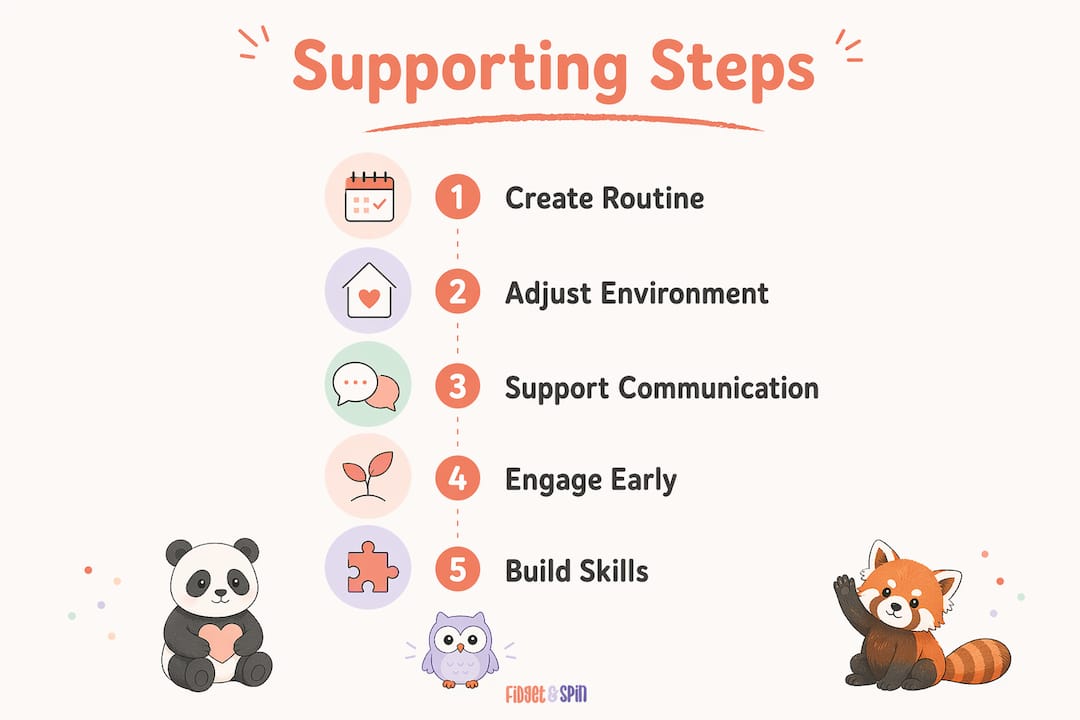
Communication is broader than speech. Your child may use gestures, pointing, facial expressions, vocalisations, AAC devices, PECS cards, or a combination of all of these. Every single one counts. Broadening your own definition of communication is the first step, because if you are only listening for words, you will miss most of what your child is telling you.

Play builds communication skills in ways that drills and flashcards simply cannot match. Following your child’s lead in play, commenting on what they are doing rather than quizzing them, and narrating your own actions all build language without pressure. Simple, repeatable phrases work better than complex sentences. “Your turn.” “More?” “All done.” These are not dumbed-down language. They are the scaffolding your child can actually grab onto.
Offering choices within your child’s current ability is a practical way to build communication and agency at the same time. “Do you want the red cup or the blue cup?” gives your child a real reason to communicate and a guaranteed win. Validate the message before you address the behaviour. If your child throws a cup because they want more juice, get the juice first, then gently model the words or sign.
- Use AAC, PECS, or signing alongside speech, not instead of it.
- Repeat key words consistently across all caregivers.
- Narrate daily activities in short phrases: “Washing hands. Soap on. Rinse off.”
- Respond to all communication attempts, including non-verbal ones.
- Avoid bombarding your child with questions. Statements invite more response than interrogation.
Understanding social communication as a distinct skill set helps parents see why their child might struggle with back-and-forth interaction even when their vocabulary is growing. It is not stubbornness. It is a processing difference.
What does early intervention actually involve, and how do you stay involved?
Early intervention before age five produces stronger social and communication outcomes over time. If your child is under three, you can contact early intervention programmes directly without waiting for a GP referral in many areas. The earlier the support starts, the more the developing brain can build on it.
Applied Behaviour Analysis, known as ABA, is one of the most researched approaches for autistic toddlers. ABA therapy for two-year-olds typically involves 10–20 hours per week, overseen by a Board Certified Behaviour Analyst (BCBA) who tailors the programme to the individual child. That is a significant time commitment, and it is worth knowing upfront so you can plan around it.
The research is clear that parents as co-therapists produce better outcomes than clinic-only work. Skills generalise when they are practised during bath time, mealtimes, and the walk to the park, not just in a therapy room on a Tuesday afternoon. Your involvement is not optional extra credit. It is the mechanism by which therapy actually works at home.
| Approach | Typical hours per week | Who leads it | Key feature |
|---|---|---|---|
| ABA therapy | 10–20 hours | BCBA with parent involvement | Breaks skills into small, measurable steps |
| Speech and language therapy | 1–2 hours | Speech and language therapist | Targets communication and feeding |
| Occupational therapy | 1–2 hours | Occupational therapist | Addresses sensory processing and self-care |
| Parent-led home practice | Daily | You | Embeds skills into natural routines |
Pro Tip: Ask your BCBA to show you the exact prompting technique they use in sessions, then practise it yourself during snack time or getting dressed. Consistency between sessions and home is what makes skills stick.
Which daily activities build self-care and social skills in small, manageable steps?
Teaching self-care to an autistic toddler works best when you shrink the task down to its smallest possible unit. Brushing teeth is not one task. It is picking up the brush, putting on the toothpaste, opening the mouth, moving the brush, rinsing, and spitting. Reinforcing each micro-step with specific praise, “You put the toothpaste on, brilliant,” builds confidence and momentum without overwhelming your child with the full sequence at once.
Visual schedules and positive routines reduce the stress of daily tasks significantly. First-and-then language is simple and powerful: “First shoes, then playground.” It gives your child a clear picture of what is happening and what comes next, without a long verbal explanation they may not be able to process in the moment.
Sensory regulation activities woven into the daily routine do double duty. They help your child stay regulated and they build body awareness and motor skills at the same time. Check out these sensory regulation activities for practical ideas you can use at home today.
- Break every self-care task into three to five micro-steps and teach one step at a time.
- Use a picture schedule for morning and bedtime routines, placed at your child’s eye level.
- Add a sensory warm-up before tricky tasks: five jumps on a trampoline, a tight hug, or squeezing a stress ball.
- Use first-and-then language consistently across all caregivers and settings.
- Offer gentle social interaction opportunities that match your child’s current capacity, parallel play before cooperative play, side-by-side before face-to-face.
- Celebrate the attempt, not just the outcome. “You tried the zip. That was great.”
Key takeaways
Supporting an autistic toddler requires consistent routines, sensory-aware environments, and active parent involvement across therapy, communication, and daily self-care.
| Point | Details |
|---|---|
| Regulate before you correct | Help your child reach a calm state before attempting to teach or redirect behaviour. |
| Routines reduce anxiety | Predictable daily sequences lower stress and create the conditions for learning. |
| Communication is broader than speech | AAC, PECS, gestures, and vocalisations all count as valid communication. |
| Early intervention matters | Structured support before age five produces stronger long-term outcomes. |
| Micro-steps build real skills | Praise each small step in a self-care task rather than waiting for full completion. |
What I have actually learnt from doing this every day
I spent a long time trying to find the right group, the right session, the right birthday venue for Remy. We left soft play early more times than I can count. I watched him cover his ears in a room full of children who were just having fun, and I felt the familiar mix of protectiveness and helplessness that I suspect every parent reading this knows well.
What shifted things for me was not a single breakthrough. It was accumulation. A visual schedule that actually worked. A BCBA who showed me how to prompt without hovering. A morning routine so consistent that Remy stopped fighting it and started leading it himself. None of that happened quickly, and none of it happened perfectly.
The thing I wish someone had told me earlier is that the goal is not to fix your child. The goal is to reduce the friction between their nervous system and the world, so they can show you who they are. That reframing changed how I approached every single strategy in this article.
Self-compassion is not a luxury for SEN parents. It is load management. You cannot regulate a dysregulated child if you are dysregulated yourself. The days I got it wrong taught me more than the days I got it right. Both kinds of days count.
— Caitlin
Sensory play that puts these strategies into practice
If you are looking for a space where the environment is already set up to support your child’s regulation, rather than working against it, Fidget and Spin runs weekly sensory sessions in Brighton and Hove for neurodiverse children aged 1–6.
Each session is built around three zones: big movement, low-stimulation cosy space, and tactile play. Your child moves between them at their own pace, with no pressure to perform or participate on anyone else’s terms. It is the kind of space Anthony and I built because we could not find it anywhere else. Book a sensory play session and see what it feels like to walk into a room where your child just fits. We also run SEN-friendly birthday parties across Brighton, Hove, and wider Sussex for ages 1–7, if you want a celebration that does not require you to spend the whole time managing the environment.
FAQ
What is the most effective first step when supporting an autistic toddler?
Creating a predictable daily routine is the most effective first step. Predictability reduces anxiety and gives your child the safety they need to learn new skills.
At what age should I seek early intervention for my autistic toddler?
Early intervention before age five produces the strongest outcomes. If your child is under three, you can contact early intervention programmes directly without a GP referral in many areas.
How many hours of ABA therapy does a two-year-old typically need?
ABA therapy for two-year-olds typically involves 10–20 hours per week, based on an individual assessment by a Board Certified Behaviour Analyst.
How do I support communication if my toddler is not yet speaking?
Use AAC tools, PECS cards, signing, and gesture alongside any speech your child has. Respond to every communication attempt, verbal or not, to build confidence and connection.
How can I teach self-care skills without causing meltdowns?
Break every task into micro-steps and praise each one individually. Visual schedules and first-and-then language reduce the stress of transitions and daily routines significantly.
Recommended
- Step by step early years inclusion: a parent’s guide | Fidget and Spin Brighton
- Parent support tips for raising neurodiverse children | Fidget and Spin Brighton
- A practical guide to emotional regulation for SEN children | Fidget and Spin Brighton
- What is neurodiversity? A guide for parents and carers | Fidget and Spin Brighton