TL;DR:
- Autism friendly party games focus on sensory sensitivity, structure, and inclusive participation without elimination.
- Proper environment setup with quiet zones and visual schedules is essential for children’s engagement and comfort.
Autism friendly party games are defined as activities designed to be sensory-sensitive, socially accessible, and free from pressure to compete or conform. They prioritise predictable structure, flexible participation, and sensory regulation over winning or elimination. For neurodiverse children, the difference between a game that works and one that doesn’t often comes down to noise level, turn-taking clarity, and whether a child can step back without feeling singled out. This guide covers the games that actually hold up in practice, how to adapt the classics, and how to set up a space where every child can genuinely enjoy themselves.
1. Top autism friendly party games for neurodiverse children
The games below share three qualities: predictable structure, low sensory load, and no elimination. Each one gives children a reason to stay engaged without forcing social interaction they’re not ready for.

Chat Chains
Chat Chains is a turn-taking conversation game built around 150 structured prompts. It reduces social anxiety by giving children a clear sequence to follow. Nobody has to think of something to say on the spot. That alone removes a huge amount of pressure for autistic children who find unstructured conversation difficult.
Bubble play
A bubble machine running quietly in a corner is one of the most effective sensory-supportive activities you can offer at a party. Occupational therapists recommend it over loud, fast-paced games. Children can engage as much or as little as they like. There’s no turn-taking required, no winner, and the visual input is calming rather than alerting.
Obstacle courses with clear rules
A simple obstacle course with visual markers at each station gives children a clear, predictable path through physical play. The rules don’t change mid-game. Children who are sensory-seeking get the movement they need, and children who prefer to watch can observe without pressure. Keep the course short, well-lit, and free from unexpected sounds.
Musical statues without elimination
Modified musical statues keeps everyone playing regardless of who moves. When the music stops, nobody sits down. Children simply freeze and then carry on. This is a direct application of invisible inclusion, which adapts mainstream game rules so no child is excluded or singled out. The game stays fun without the anxiety spike that comes with being “out.”
Sensory bins and tactile stations
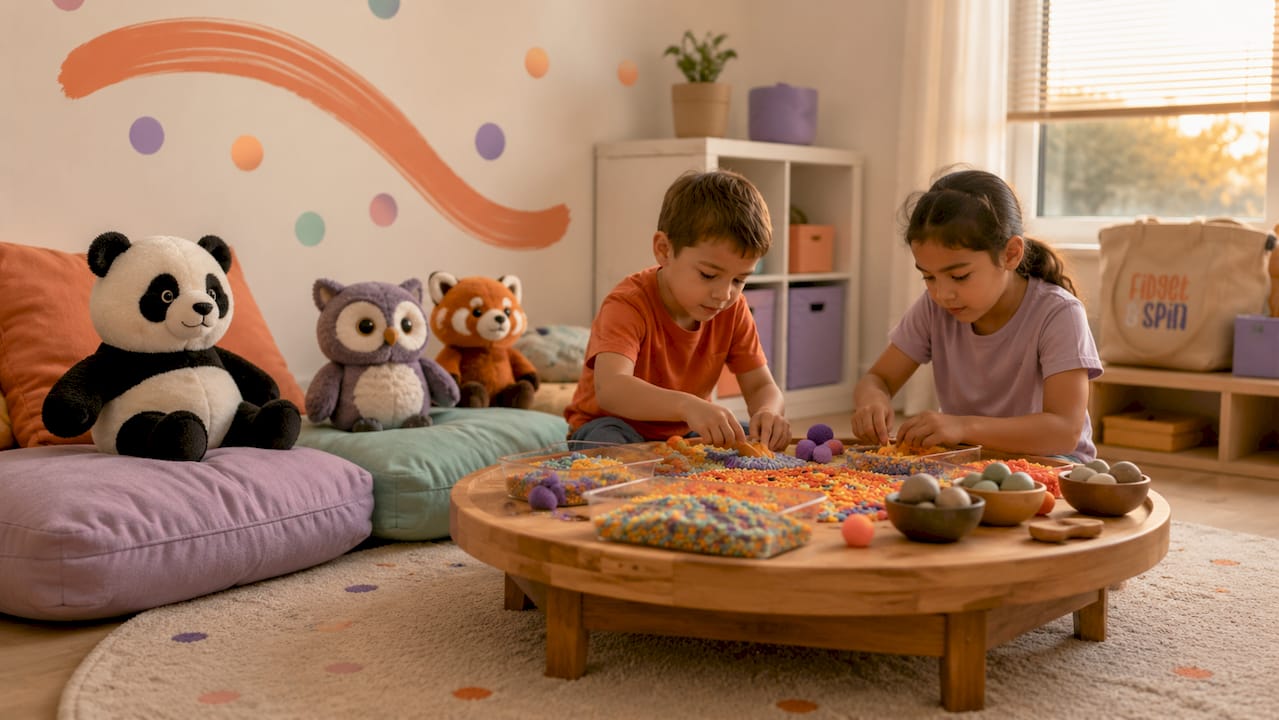
A tactile bin filled with kinetic sand, dried pasta, or water beads is not a traditional party game, but it functions as one. Children gather around it, interact at their own pace, and regulate their sensory input naturally. Parallel play is a valid form of social connection for many autistic children. You don’t need everyone sitting in a circle to have a shared experience.
Parachute games
A parachute game is one of the best inclusive party activities for mixed groups. Everyone holds an edge. The movement is predictable. Children can hold tightly or loosely depending on their sensory preferences. Variations like “popcorn” (bouncing soft balls on the parachute) add visual interest without increasing noise.
Cooperative building challenges
Give small groups a pile of soft blocks or cardboard tubes and a simple goal: build the tallest tower, or make a bridge. There’s no competition between children. The focus is on the task, not on each other. This suits children who find direct social interaction tiring but enjoy working alongside others.
Story dice
Story dice use illustrated cubes to prompt shared storytelling. One child rolls, names what they see, and passes the dice on. There’s no wrong answer. Children who use AAC or PECS can participate fully because the prompt is visual, not verbal. The turn-taking structure is clear and the pace is gentle.
Pro Tip: Assign roles of equal value across all games, such as “dice keeper,” “timer holder,” or “spinner operator.” Equal participation roles avoid the social anxiety that comes with being singled out as a helper, and they give every child a clear sense of purpose.
2. How to adapt traditional party games for neurodiverse guests
Most classic party games can work with a few straightforward changes. The goal is to remove elimination, reduce unpredictability, and give children a way to participate at their own level.
Musical chairs without the “out” mechanic. Remove one chair but don’t remove any children. When the music stops, children find a seat and share if needed. Modifying musical chairs this way takes less than ten minutes to set up and removes the moment of public exclusion that causes the most distress. The game continues at the same pace with the same energy. Nobody leaves the circle.
Adjusting volume and pace. Turn the music down. Slow the countdown. Give children a visual cue (a raised hand or a coloured card) before transitions happen. Sudden loud sounds are one of the most common sensory triggers at parties. A simple volume adjustment changes the experience entirely.
Replacing competitive rules with cooperative ones. Pass the Parcel becomes a guaranteed-prize game when every layer contains a small treat. Pin the Tail on the Donkey becomes a no-pressure craft activity when children simply place their sticker wherever they like. The activity stays recognisable but the anxiety around winning disappears.
- Remove elimination rules from any game where a child must sit out
- Use visual schedules or simple picture cards to show the game sequence before it starts
- Offer a “watching role” as a legitimate way to participate
- Keep rounds short, around two to three minutes, to avoid sensory fatigue
- Prepare children with a brief social story about what the game involves before the party
Pro Tip: A visual schedule showing the party order (games, food, cake, home) reduces transition anxiety significantly. Print it large, laminate it, and put it somewhere children can check it themselves.
3. Setting up a sensory-friendly party environment
The games matter, but the environment matters just as much. A child who is already overwhelmed by noise and light before a game starts will not be able to engage with it, however well-designed it is.
The station approach divides the party space into distinct zones for different activity intensities. One area for active play. One for quiet crafting or sensory bins. One low-stimulation corner with cushions, dim lighting, and a few fidget tools. Children move between zones as they need to, self-regulating without adult intervention.
- Quiet zone: A corner with a tent or canopy, soft lighting, and noise-reducing headphones available
- Active zone: Space for movement games, kept away from the food and seating area
- Tactile zone: Sensory bins, playdough, or water play with low background noise
- Visual schedule: Posted at child height at the entrance so children know what to expect
- Sensory tools: Fidget toys, weighted lap pads, and chewable jewellery available without comment
Lighting and noise are the two factors parents most often underestimate. Fluorescent overhead lights and background music running simultaneously create a sensory load that builds quietly until it doesn’t. Use lamps, fairy lights, or natural light where possible. Keep music to one zone only.
Recognising early signs of sensory overload means a child can be supported before they reach crisis point. Covering ears, withdrawing, or becoming very still are all signals. Having a calm adult stationed near the quiet zone, rather than circulating with a camera, makes a real difference.
4. Which games suit different party situations?
Not every game works for every group. The right choice depends on the size of the group, the venue, and the sensory profiles of the children attending.
Small groups (two to six children) suit quieter, more intimate games. Chat Chains, story dice, and cooperative building challenges all work well when children know each other. The lower social demand means children can take longer turns and the pace stays calm.
Larger groups need activities where children can participate at the edges without being noticed. Parachute games, bubble play, and obstacle courses all allow peripheral involvement. A child who wants to watch from the side is still part of the group.
Outdoor parties open up options for movement-based play without the acoustic problems of indoor venues. Obstacle courses, parachute games, and bubble stations all translate well outside. The absence of echo and reverberation alone reduces sensory load considerably.
Sensory-seeking children benefit from games with physical input: obstacle courses, parachute play, and tactile bins. Sensory-avoiding children do better with low-movement, visually calm activities: story dice, Chat Chains, and quiet craft stations.
Build in permission to leave a game early without it being a big moment. A child who steps away from a game and goes to the quiet zone is regulating, not failing. Educational games for neurodiverse kids that build on these same principles can extend the learning well beyond the party itself.
Key takeaways
The most effective autism friendly party games remove elimination, reduce sensory load, and give every child a clear and equal role to play.
| Point | Details |
|---|---|
| Remove elimination rules | Games like modified musical chairs keep every child in play and reduce anxiety. |
| Use the station approach | Divide the space into active, quiet, and tactile zones so children self-regulate. |
| Assign equal roles | “Spinner operator” or “dice keeper” roles give every child purpose without singling anyone out. |
| Prepare with visual schedules | A printed party order reduces transition anxiety before the event begins. |
| Match games to sensory profiles | Sensory-seeking children need movement; sensory-avoiding children need calm, low-input activities. |
What I’ve learnt from hosting parties for kids like Remy
I used to dread Remy’s birthday parties. Not the planning part. The moment when I’d watch him clock the noise, the balloons, the twenty children he didn’t know, and I’d see him start to shut down before we’d even sung Happy Birthday. We tried a mainstream soft play venue once. We left forty minutes in. I cried in the car park.
What changed things wasn’t finding a magic game. It was understanding that the environment and the game design work together. When we removed the elimination mechanic from every game, when we put a quiet corner in the room and told children they could use it whenever they wanted, when we gave Remy the job of “spinner operator” so he had a role that made sense to him, he stayed. He played. He actually had fun. That still feels like a big deal to say out loud.
The thing I’d tell any parent reading this is: you don’t need a perfect party. You need a party where your child feels safe enough to try. Neuro-affirming play isn’t about lowering expectations. It’s about removing the barriers that were never necessary in the first place. Inclusive play design starts from the assumption that every child can participate. That assumption changes everything.
Anthony and I built Fidget and Spin because we couldn’t find what Remy needed. Every session and every party we run is built around the same principles in this article. We know they work because we’ve watched them work, with our own child and with hundreds of others.
— Caitlin
Sensory birthday parties in Brighton built for neurodiverse children
If you’re planning a party and the thought of a mainstream venue makes your stomach drop, Fidget and Spin’s sensory birthday parties are designed specifically for children like yours.
Anthony and I run SEN-friendly parties for children aged 1–7 across Brighton, Hove, and wider Sussex. Every party uses the station approach, sensory tools, and game formats from this article. The space is set up before guests arrive, the environment is controlled for noise and lighting, and there is always a quiet zone. Packages start at £220. No mainstream venue chaos, no side-eye, no leaving early. Just a party where your child gets to be exactly who they are.
FAQ
What makes a party game autism friendly?
An autism friendly party game has predictable structure, no elimination, and low sensory load. It gives children a clear role and allows flexible levels of participation without pressure.
Can you modify traditional games like musical chairs?
Yes. Removing the elimination mechanic from musical chairs takes less than ten minutes and keeps every child in the game. Simply stop removing chairs and let children share seats when the music stops.
How do I manage sensory overload at a party?
Use the station approach to create a quiet zone with dim lighting and sensory tools. Watch for early signs such as covering ears or withdrawing, and have a calm adult near the quiet area throughout.
What games work for non-verbal or AAC-using children?
Story dice, sensory bins, parachute games, and bubble play all support participation without requiring verbal responses. Sensory regulation activities built around tactile and visual input are particularly accessible.
How long should party games last for autistic children?
Keep individual game rounds to two to three minutes. Sensory-sensitive parties typically run for around two hours with unlimited access to activity zones, allowing children to engage and disengage at their own pace.
Recommended
- Birthday party for a non verbal child: a real guide | Fidget and Spin Brighton
- Sensory party Hove: top inclusive options for neurodiverse kids | Fidget and Spin Brighton
- Promoting gentle social interaction for neurodiverse kids | Fidget and Spin Brighton
- Group activities for SEN children: a practical guide | Fidget and Spin Brighton