
TL;DR:
- Effective sensory play for neurodiverse children requires safe materials, responsive supervision, and structured routines that adapt to individual sensory profiles. Short, regular sessions with clear boundaries and attentive observation help children build regulation and trust while minimizing overwhelm. The key is prioritizing relationship and responsiveness over elaborate setups or expensive equipment to support emotional and sensory development.
Sensory play best practices are defined by three non-negotiables: age-appropriate materials, close supervision, and genuine responsiveness to your child’s sensory cues. Not the fanciest bin. Not the most Pinterest-worthy setup. Those three things. For neurodiverse children aged 1–7, including autistic children, those with ADHD, PDA, and sensory processing differences, getting these foundations right is what separates a session that supports regulation from one that ends in a meltdown on the kitchen floor (we’ve been there). NYU Steinhardt’s Early Childhood Education director describes sensory play as foundational brain infrastructure that supports regulation and focus. That framing matters. This isn’t messy fun for its own sake. It’s how our children learn to make sense of the world.
What are the best practices for sensory play?
The term “sensory play” gets used loosely, but in occupational therapy and early years practice, it refers to structured or semi-structured activities that engage one or more of the senses to support regulation, learning, and development. For neurodiverse children, the benefits of sensory play go beyond entertainment. BBC Tiny Happy People describes sensory play as building cause-and-effect understanding and emotional awareness by connecting what children feel, hear, and see. That connection is the point.
The core principles are simple to state and genuinely hard to hold onto in a tired Tuesday afternoon moment:
- Choose materials that are safe and suited to your child’s developmental stage.
- Watch your child, not your phone, during sessions.
- Follow their lead. Stop when they signal enough.
- Keep setups contained and predictable.
- Prioritise process over product. There is no correct way to play with oats.
These principles apply whether you’re at home with a washing-up bowl or at a dedicated sensory space. The setting matters less than the approach.
How do you choose safe materials for sensory play?
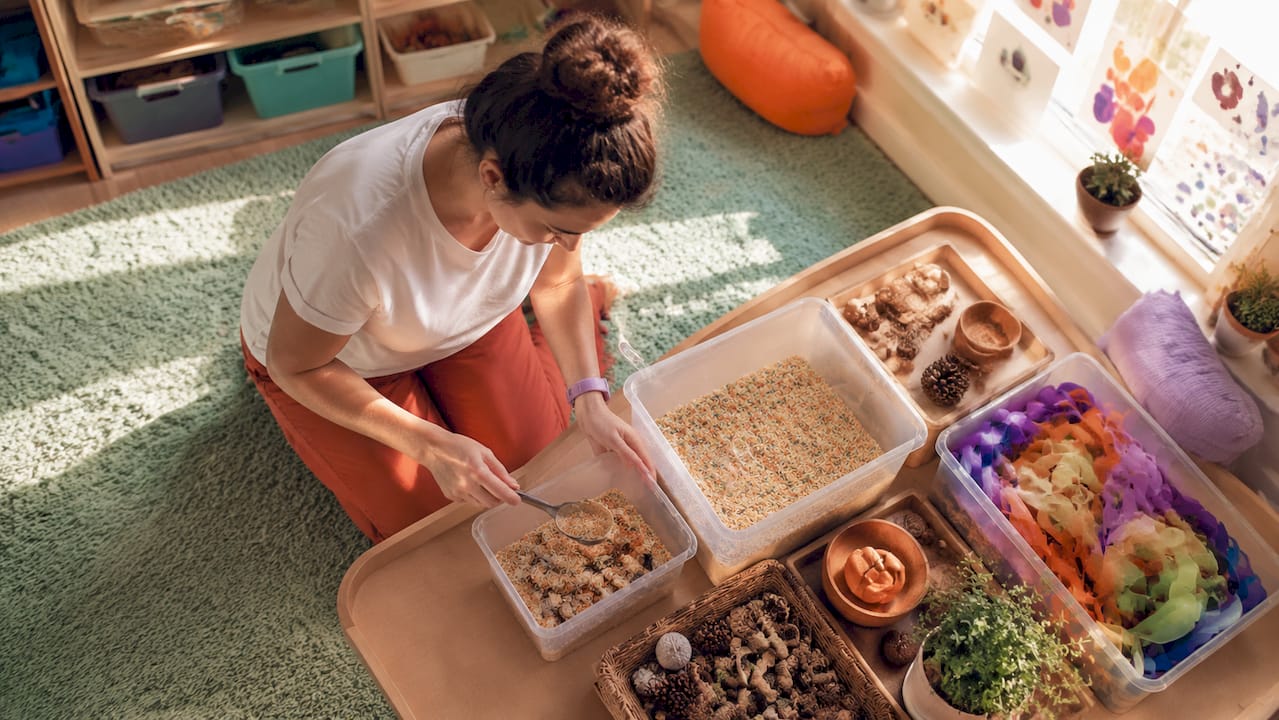
Material selection is where most parents either overthink or underestimate the risks. Supervision and material choice are the biggest best-practice distinctions between ordinary play and sensory play for toddlers. That’s not a small claim. It means the specific activity matters less than what you put in it and whether you’re watching.

For children aged 1–3, the choking risk is the primary concern. HealthyChildren.org advises choosing larger grains like oats or pasta over tiny beads or marbles, with close supervision throughout. A practical rule: if it fits inside a toilet paper roll, it does not belong in a toddler’s sensory bin.
Beyond safety, consider your child’s sensory preferences:
- Calming textures: cool water, smooth playdough, dry rice, soft fabric scraps.
- Stimulating textures: slime, kinetic sand, bumpy rubber balls, dried pasta.
- Taste-safe options for mouthers: cooked spaghetti, jelly, oat-based dough, yoghurt.
- Low-mess alternatives for sensory-avoidant children: sealed zip-lock bags filled with hair gel and glitter, or textured fabric boards.
Hygiene matters too. Wash bins and tools between sessions. Discard any wet or food-based materials after use. Mould in a sensory bin is not a sensory experience anyone needs.
Pro Tip: Start with one texture per session rather than a mixed bin. This makes it easier to spot what your child enjoys or avoids, and it reduces the chance of overwhelm before you’ve even begun.
How should you structure a sensory play session?
Structure is where a lot of well-intentioned sessions fall apart. You set up a beautiful bin, your child tips it on the floor in thirty seconds, and you spend the next twenty minutes negotiating cleanup while they’re already dysregulated. Sound familiar?
Frequent, brief sensory play sessions work better than rare, lengthy ones. Short and often beats long and occasional every time. Ten minutes of engaged, calm play is worth more than forty minutes that ends in tears.
Here’s a session structure that works well for many neurodiverse children aged 1–7:
- Give a visual or verbal warning before the session starts. “We’re going to do water play in a minute.” This reduces the shock of transition.
- Set up the space before your child arrives. Bin on a mat, two or three items maximum, towel nearby.
- Invite, don’t instruct. Sit beside them and explore the material yourself. Let curiosity do the work.
- Watch for saturation signals: turning away, increased movement, vocalising distress, or pushing materials away. These mean stop now, not in a minute.
- Build in a predictable ending. A cleanup song, a timer, or a consistent phrase like “all done, let’s wash hands” reduces power struggles significantly.
- Follow with a calming activity if the session was stimulating, or a movement break if it was calm.
Starting with one to two textures and a predictable cleanup routine eases overwhelm and reduces the friction around endings. That consistency is what builds trust over time.
Pro Tip: If cleanup is a battle, make it part of the play. Scooping rice back into a container with a spoon is still sensory play. Pouring water out with a cup counts too. The session doesn’t have to end the moment you decide it does.
How do you adapt sensory play to your child’s individual needs?
Every neurodiverse child has a different sensory profile. Remy, my son, is sensory-seeking in some areas and sensory-avoidant in others, sometimes within the same afternoon. What works on Monday might not work on Thursday. That’s not failure. That’s just how sensory processing differences work.
Matching sensory input to a child’s preferences and adjusting the sense load reduces the risk of overstimulation. The practical version of this looks like:
- Observe before you intervene. Watch how your child approaches new materials. Do they touch immediately or hang back? Do they mouth, smell, or avoid?
- Change one variable at a time. If you’re not sure whether it’s the texture, the temperature, or the noise of the activity that’s causing distress, adjust one thing and watch again.
- Use a sensory diet framework. Occupational therapists use planned sensory activities to help children reach a regulated, “just right” state. You don’t need a formal OT plan to apply this thinking at home. You just need to notice what helps your child feel calm and ready, and build those activities into the day.
- Allow open-ended exploration. The goal, as BBC Tiny Happy People puts it, is to help children make meaning from sensory experiences, not to direct them toward a correct way to play.
“The goal isn’t a tidy bin or a finished product. The goal is a child who feels safe enough to explore.”
If you want to go deeper on OT-aligned sensory support, there’s a lot of practical guidance available that doesn’t require a referral to access.
What are the best sensory play ideas for neurodiverse children?
The best sensory play ideas are the ones your child will actually engage with. That sounds obvious. It isn’t. We’ve all bought the expensive sensory kit that got ignored in favour of a bowl of cold pasta.
Here are activities that work across the 1–7 age range, organised by sensory focus:
| Activity | Sensory Focus | Age Range | Notes |
|---|---|---|---|
| Water play with cups and funnels | Tactile, visual | 1–7 | Use a washing-up bowl on a mat; add food colouring for visual interest |
| Texture basket (fabric, wood, metal) | Tactile, proprioceptive | 1–3 | No loose small parts; rotate items weekly |
| Kinetic sand or moon sand | Tactile, proprioceptive | 3–7 | Contained in a tray; not taste-safe |
| Oat or rice sensory bin | Tactile, auditory | 2–6 | Taste-safe; add scoops, funnels, small figures |
| Shaving foam on a tray | Tactile, olfactory | 3–7 | Supervise closely; avoid near eyes |
| Sensory bottles (sealed) | Visual, vestibular | 1–4 | Glitter, water, and oil in a sealed bottle; no choking risk |
Natural materials like sand, water, leaves, and mud offer multi-sensory exploration without any cost. Household items, a colander, a wooden spoon, a piece of velvet, often outperform purpose-built sensory toys.
For early years play strategies that go beyond the bin, think about proprioceptive activities like pushing a heavy trolley, carrying a bag of rice, or climbing. These are sensory activities too, and often the most regulating ones for children who seek deep pressure.
Managing mess is a real concern, not a neurotic one. A shower curtain under the play area, a dedicated “messy play” outfit, and a clear “this is the messy play space” boundary all reduce the cognitive load for you and the predictability anxiety for your child.
What are the most common sensory play mistakes?
Most sensory play mistakes come from good intentions applied without enough information. Here are the ones I see most often, and how to avoid them:
- Using age-inappropriate materials. Sensory play age mismatches create hidden choking risks, especially when infants are exposed too soon to loose fillers like dried lentils or small beads. Check developmental stage, not just age on the box.
- Ignoring saturation signals. A child turning away, going rigid, or suddenly becoming very loud is not being difficult. They are communicating. Stop the session.
- Overcomplicating the setup. A bin with fifteen different textures and ten tools is overwhelming for most neurodiverse children. Limiting items in sensory bins and using containment reduces overload and simplifies supervision.
- Leaving the room. Supervision is not optional. A well-planned sensory space can still escalate into sensory distress without an adult present to pause or change the input.
- Skipping the cleanup routine. Abrupt endings cause dysregulation. A consistent, predictable ending is part of the session, not an afterthought.
Key takeaways
Effective sensory play for neurodiverse children depends on safe materials, responsive session structure, and consistent adaptation to each child’s individual sensory profile.
| Point | Details |
|---|---|
| Material safety comes first | Use larger grains and taste-safe options for under-threes; nothing that fits inside a toilet paper roll. |
| Short sessions beat long ones | Brief, frequent play supports regulation better than occasional lengthy sessions. |
| Follow your child’s cues | Stop when saturation signals appear; pausing is not failure, it is good practice. |
| Change one variable at a time | Adjust one sensory element per session to identify what soothes or stimulates your child. |
| Predictable endings reduce conflict | A consistent cleanup routine is part of the session and reduces power struggles significantly. |
What i’ve learnt from getting it wrong first
I spent the first year of Remy’s sensory play life doing it backwards. I’d set up elaborate bins I’d seen on Instagram, he’d tip them over in thirty seconds, I’d feel like I’d failed, and he’d be dysregulated for the rest of the afternoon. I thought the problem was the materials. It wasn’t. The problem was the structure, or the lack of it.
What actually helped was stripping everything back. One texture. A mat. A warning before we started. A song when we finished. That was it. The transformation wasn’t dramatic or instant. But over weeks, he started to trust the routine. He’d come to the mat willingly. He’d stay longer. He’d even, occasionally, help scoop things back into the bin (I’m not saying it was graceful, but it happened).
The thing nobody tells you is that sensory play for neurodiverse children is not about the activity. It’s about the relationship between you and your child in that moment. The materials are just the medium. Your attentiveness is the actual intervention.
I’m also sceptical of the idea that you need specialist equipment or a dedicated sensory room to do this well. Remy’s most regulated sensory sessions have involved a bowl of cold water and a plastic cup. His most dysregulating ones have involved expensive kits I bought in a moment of optimism. Trust what your child shows you, not what looks good in a flat lay.
If you’re just starting out, read about sensory play strategies for neurodiverse kids and then put the reading down and watch your child. They’ll tell you more than any article will.
— Caitlin
Try sensory play in a space built for your child
If you’ve been doing sensory play at home and wondering what it looks like with proper space, proper zones, and other families who just get it, come and see what we’ve built.

At Fidget and Spin in Brighton and Hove, our weekly SEN stay and play sessions are designed around exactly the best practices in this article. Three sensory zones, Wiggle and Bounce for big movement, Snuggle and Chill for low-stimulation rest, and Squish and Squeeze for tactile play, give children the chance to self-select their sensory input. Sessions are small, calm, and led by SEN parents who know what it feels like to leave a mainstream group early. No side-eye. No “he just needs to get used to it.” Just play, on your child’s terms. See how our sessions work and book a spot that fits your week.
FAQ
What materials are safest for toddler sensory play?
For children aged 1–3, use larger grains like oats, cooked pasta, or rice rather than small beads or marbles. HealthyChildren.org recommends avoiding anything that fits inside a toilet paper roll due to choking risk.
How long should a sensory play session last?
Short and frequent works better than long and occasional. Ten to fifteen minutes of engaged play is enough for most toddlers and preschoolers. Stop when your child shows signs of saturation, such as turning away, increased agitation, or pushing materials aside.
How do i know if sensory play is helping my child regulate?
Watch for a calmer, more focused child after sessions rather than during them. Over time, consistent sensory play that matches your child’s profile supports the brain infrastructure needed for attention and self-regulation.
Do i need specialist equipment for sensory play at home?
No. Water, oats, fabric scraps, and household containers are among the most effective sensory materials available. The structure of the session and your responsiveness to your child matter far more than the equipment.
What should i do if my child refuses sensory play?
Respect the refusal. Offer the material without pressure, explore it yourself nearby, and try again another day. Forcing sensory engagement causes avoidance. Patience and consistency build willingness over time.
Recommended
- Effective sensory play strategies for neurodiverse kids | Fidget and Spin Brighton
- Sensory play explained for neurodiverse children | Fidget and Spin Brighton
- Effective early years play strategies for neurodiverse children | Fidget and Spin Brighton
- How to make play inclusive for neurodiverse kids | Fidget and Spin Brighton