
TL;DR:
- Sensory play actively engages children’s senses and supports their development, especially in neurodiverse children. Research shows it improves cognitive, motor, language, and emotional regulation skills, with routines and tailored materials enhancing effectiveness. Observing and responding to individual signals is crucial for meaningful sensory experiences and regulation.
Sensory play is defined as any activity that actively engages one or more of a child’s senses, and its impact on neurodiverse children’s development is measurable, significant, and well-documented. A 2026 study published in the Anatolian Journal of Health Research found that a structured sensory experience programme with infants aged 12–36 months produced statistically significant gains across cognitive, fine motor, language, and social-emotional domains. NYU’s Erin O’Connor describes sensory play as supporting early brain wiring and the neural infrastructure children need for focus, emotional regulation, and cognitive flexibility. For those of us raising autistic, ADHD, or PDA children, that is not abstract science. It is what we see when Remy finally settles into a tray of kinetic sand after a morning that felt impossible. The importance of sensory experiences is not a nice-to-have. It is foundational.
How does sensory play support child development?
Remy was about two when I first noticed that certain textures completely stopped him in his tracks. Not in a bad way. In a he has gone somewhere very focused and very calm way. That observation sent me down a research rabbit hole I have never fully climbed out of.
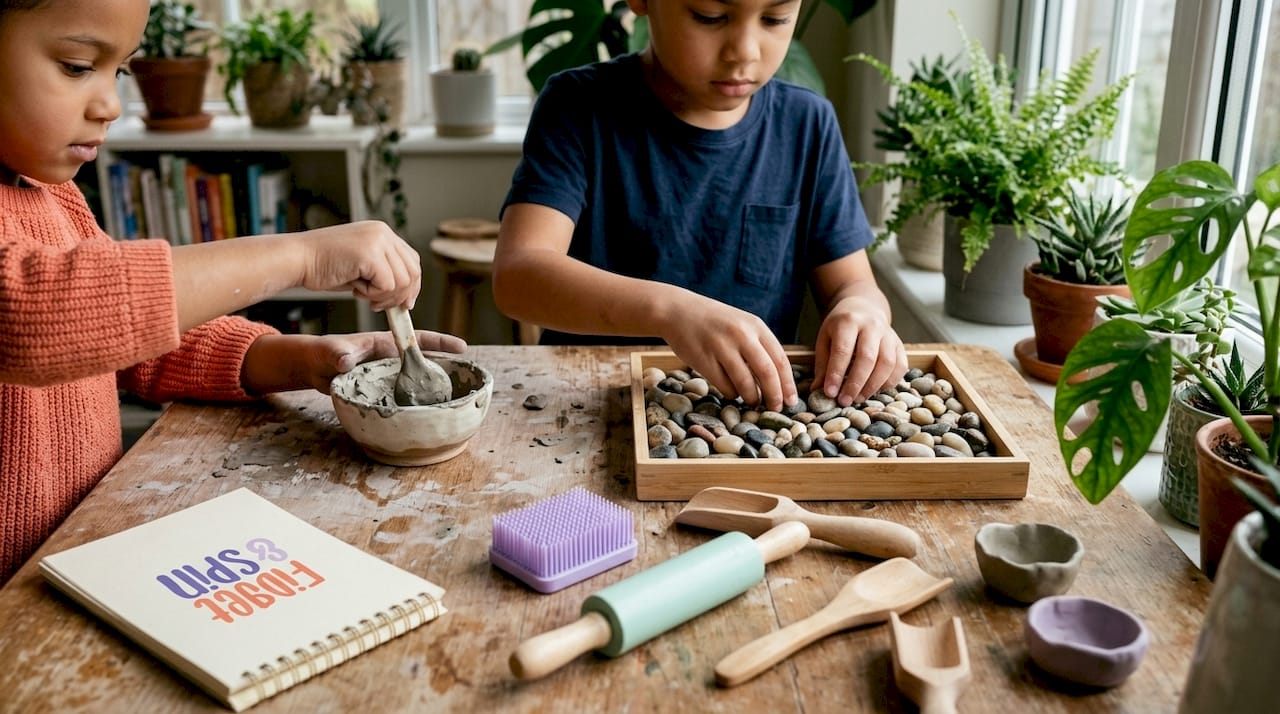
The developmental case for sensory play is strong across every domain that matters in the early years.
Cognitive and language gains
The 2026 Anatolian Journal study measured outcomes using the Denver II developmental screening tool and sensory rubrics. Children in the sensory experience programme showed significant posttest gains in touch, smell, vision, hearing, language, and cognitive skills. That breadth matters. It tells us sensory play is not narrowly useful. It works across the whole child.
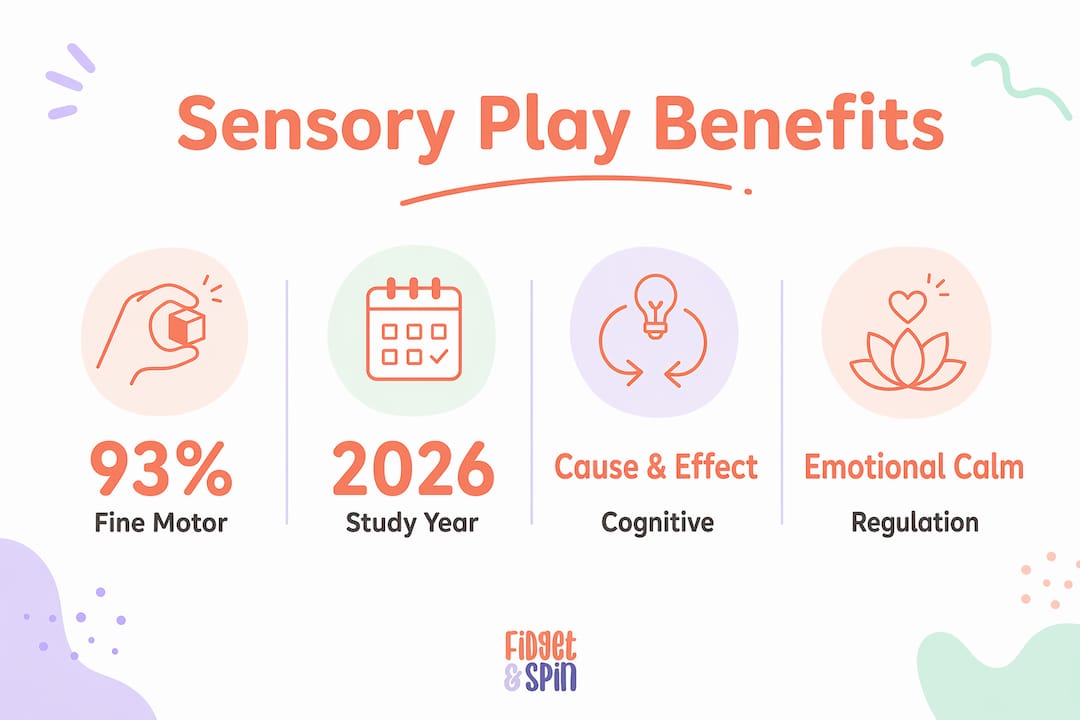
Erin O’Connor at NYU explains that sensory play encourages cause-and-effect learning naturally, without instruction. A child pouring water from one container to another is learning volume, gravity, and prediction simultaneously. No flashcard required.
Fine motor and tactile development
Research using natural materials including sand, seeds, and clay found a 93% effectiveness rate in fine motor improvement in early childhood settings. That figure is striking. It means the cheap stuff, the stuff you find in a garden or a beach bag, is doing serious developmental work.
Natural materials also encourage creativity and cooperation in ways that manufactured toys often do not. Two children sharing a lump of clay have to negotiate, take turns, and respond to each other. That is social-emotional learning happening in real time.
Social-emotional development
BBC Tiny Happy People notes that sensory play helps children connect senses to build meaning and emotional awareness. When a child discovers that squeezing a stress ball or running their fingers through dry rice makes them feel calmer, they are building self-knowledge. That self-knowledge is the foundation of regulation.
Pro Tip: Try a simple sensory play strategy before a known transition, such as school pick-up or bath time. Ten minutes of tactile play beforehand can reduce the spike in dysregulation that often follows a change in routine.
| Developmental Domain | Key Benefit | Supporting Evidence |
|---|---|---|
| Cognitive | Cause-and-effect learning, focus | NYU’s Erin O’Connor, 2026 |
| Fine motor | Grip strength, hand coordination | Natural materials study, 93% effectiveness |
| Language | Vocabulary linked to sensory experience | Anatolian Journal study, 2026 |
| Social-emotional | Emotional awareness, co-regulation | BBC Tiny Happy People, Contact UK |
How does sensory play help with emotional regulation?
This is the question I get asked most by parents at our sessions. Not “will it help their speech?” but “will it help them cope?” The answer, backed by actual research, is yes.
A 2025 quasi-experimental study measured emotional regulation in children aged 4–5 before and after eight sensory play sessions. The experimental group scored a mean of 65.89 on regulation measures after the programme. The control group scored 50.13. Eight sessions. That is a meaningful shift in a short time frame.
The mechanism matters here. Sensory input, when it matches a child’s threshold, activates the body’s calming systems. It is not magic. It is physiology.
Understanding sensory over and under-responsivity
NHS Healthier Together autism guidance published in 2026 describes two ends of the sensory spectrum. Some children are over-responsive, meaning they find ordinary stimuli overwhelming. Others are under-responsive, meaning they seek out intense input to feel regulated. Many neurodiverse children experience both, depending on the day, the environment, and how much sleep everyone got.
Sensory play is not about adding more stimulation by default. It is about matching the activity to where your child is right now. That distinction matters enormously.
Practical ways to reduce sensory overload
The Contact UK charity recommends sensory breaks and calm corners as core tools for children with processing differences. NHS guidance adds specific environmental adjustments that make a real difference before any play even begins.
Here are adjustments worth trying:
- Turn off background television and reduce competing audio before a sensory activity
- Offer a low-light or dimmed space as a retreat option during play
- Keep the play area visually simple, with materials presented one at a time
- Use a consistent signal, such as a specific song or a visual cue, to mark the start and end of sensory time
- Let your child choose between two or three options rather than presenting an open-ended free-for-all
- Build in a wind-down transition after active sensory play before expecting calm behaviour
Pro Tip: If your child is already dysregulated, skip the messy play. Offer emotional regulation support through proprioceptive input first, such as heavy blankets, wall push-ups, or carrying something weighted, before introducing tactile materials.
Why do routine and predictability matter in sensory play?
I used to think variety was the goal. New textures, new materials, new setups. Remy taught me otherwise, fairly firmly, by refusing to engage with anything he had not seen before unless he had time to observe it from a safe distance first.
Sheffield Children’s NHS Foundation Trust advises using consistent sensory cues in routines to help children anticipate what is coming and regulate their response. The same sights, sounds, and smells used consistently signal safety. They tell a child’s nervous system: this is familiar, you are not in danger.
Predictability reduces the cognitive load of a sensory session. When a child knows what to expect, they can spend their energy on exploring rather than on bracing for the unknown.
Here is a simple routine framework worth trying:
- Signal the start. Use the same song, object, or phrase every time. A small basket of materials placed in a specific spot works well.
- Offer a preview. Show your child what is available before asking them to engage. Let them look before they touch.
- Follow their lead. If they gravitate to one material and stay there for twenty minutes, that is not a failure of variety. That is regulation in action.
- Avoid surprise additions. Introducing a new texture mid-session without warning can undo the calm you have built. Save new materials for the start of a session when your child is fresh.
- Signal the end. Use the same closing cue every time. A specific tidy-up song or a visual timer helps children prepare for the transition out.
NHS guidance on touch processing difficulties is clear that tactile-sensitive children need gradual, child-led exposure. Watch for non-verbal signals of discomfort and always proceed at the child’s pace. Forcing contact with a texture, even a supposedly pleasant one, can set back trust significantly.
Which sensory materials work best for neurodiverse children?
There is no universal answer here, which is both the honest truth and slightly annoying when you are standing in a craft shop wondering what to buy. What we can say is that different materials serve different purposes, and the best choice depends on your child’s sensory profile.
| Material or Setup | Best For | Watch Out For |
|---|---|---|
| Sand and kinetic sand | Fine motor, calming, open-ended exploration | Tactile-sensitive children may find dry sand aversive |
| Water tables | Proprioceptive input, cause-and-effect, cooling | Over-stimulation risk in warm or busy environments |
| Clay and playdough | Fine motor, creativity, cooperative play | Strong smell of commercial playdough can be overwhelming |
| Sensory playhouses and dens | Low-stim retreat, calming, proprioceptive pressure | Needs clear entry and exit to avoid feeling trapped |
| Fidget toys and textured objects | Regulation during transitions, focus support | Needs to match sensory preference, not just look appealing |
| Seeds, dried pasta, and natural materials | Fine motor, auditory input, low-cost and accessible | Choking risk for children under three |
Research confirms that natural materials improve fine motor skills and encourage creativity in early childhood settings. They also tend to be less visually overwhelming than brightly coloured manufactured toys, which matters for children with visual sensitivities.
Active environments like water tables suit children who need movement and proprioceptive input to regulate. Calm environments like sensory dens suit children who need to retreat and decompress. Both types of sensory space serve a genuine developmental purpose. The goal is not to pick one but to offer access to both.
For children with tactile sensitivity, start with tools rather than hands. A spoon to stir, a brush to paint, a stick to draw in sand. Indirect contact builds confidence before direct touch becomes possible.
Key takeaways
Sensory play produces measurable gains in cognitive, motor, language, and emotional regulation skills, and its effects are strongest when activities are matched to a child’s sensory profile and embedded in predictable routines.
| Point | Details |
|---|---|
| Developmental gains are broad | Research shows improvements across cognitive, fine motor, language, and social-emotional domains. |
| Emotional regulation improves quickly | Eight structured sensory sessions produced significant regulation gains in children aged 4–5. |
| Routine and predictability are key | Consistent sensory cues reduce anxiety and help neurodiverse children engage more fully. |
| Match materials to the child | Natural materials, fidgets, and calm spaces each serve different sensory profiles and needs. |
| Overload is real and avoidable | Environmental adjustments like reduced noise and visual simplicity support regulation before play begins. |
What i have learned from watching remy play
I spent a long time thinking sensory play was something I had to get right. The right materials, the right setup, the right amount of time. I would read about sensory integration strategies and feel quietly overwhelmed by the gap between the theory and my actual kitchen table.
What shifted things was watching Remy rather than managing him. He told me, without words, what worked. He moved towards the rice tray and away from the slime. He stayed at the water table for forty minutes and left the playdough untouched. He needed the den to be dark and the music to be off.
None of that matched the cheerful sensory play content I kept seeing online. But it was his sensory play, and it was working.
The research backs this up. The Contact UK charity is explicit that sensory play must be built around a child’s regulation thresholds, not a generic activity plan. The NHS guidance on touch processing is equally clear: follow the child’s signals, not the schedule.
What I would say to any parent reading this is: your observations are data. You know your child’s signals better than any study does. The research gives us the framework. You provide the translation.
And if you are in a season where sensory play feels like one more thing to get wrong, please know that a tray of dried pasta on the kitchen floor counts. It genuinely does.
— Caitlin
Come and play with us at fidget and spin
If you are looking for a space where sensory play is the whole point, not an afterthought, we would love to see you.
At Fidget and Spin in Brighton and Hove, our weekly sensory play sessions are designed specifically for neurodiverse children aged 1–6. We run three zones: Wiggle and Bounce for big movement, Snuggle and Chill for low-stim rest, and Squish and Squeeze for tactile exploration. Every session is staffed by people who get it, because we are SEN parents too. No side-eye. No pressure. No expectation that your child will engage the way anyone else’s does. If you want to understand how our sessions work before you book, that is absolutely fine. Come and have a look first.
FAQ
What is the impact of sensory play on brain development?
Sensory play supports early brain wiring by forming neural pathways linked to focus, emotional regulation, and cognitive flexibility. NYU’s Erin O’Connor describes it as building the neural infrastructure children need for future academic and social skills.
How many sessions does it take to see results?
Research shows that eight structured sensory sessions produced measurable improvements in emotional regulation in children aged 4–5. Consistent, repeated exposure matters more than any single session.
Is sensory play suitable for children who hate being touched?
Yes, with the right approach. NHS guidance on touch processing recommends starting with tools rather than hands and following the child’s pace entirely. Forced tactile contact can increase distress, so child-led exposure is the only approach worth using.
What sensory materials are best for toddlers aged 1–3?
Natural materials like sand, water, and clay are well-supported by research and accessible at low cost. Avoid small loose materials such as seeds or dried pulses for children under three due to choking risk.
Why is sensory play important for autistic children specifically?
Autistic children often experience sensory over or under-responsivity, meaning ordinary environments can be overwhelming or under-stimulating. Tailored sensory play, as recommended by NHS autism guidance, helps children regulate their nervous systems and build the emotional awareness that supports daily functioning.
Recommended
- Sensory play explained for neurodiverse children | Fidget and Spin Brighton
- Effective sensory play strategies for neurodiverse kids | Fidget and Spin Brighton
- The real impact of fidget toys on neurodiverse children | Fidget and Spin Brighton
- How to make play inclusive for neurodiverse kids | Fidget and Spin Brighton