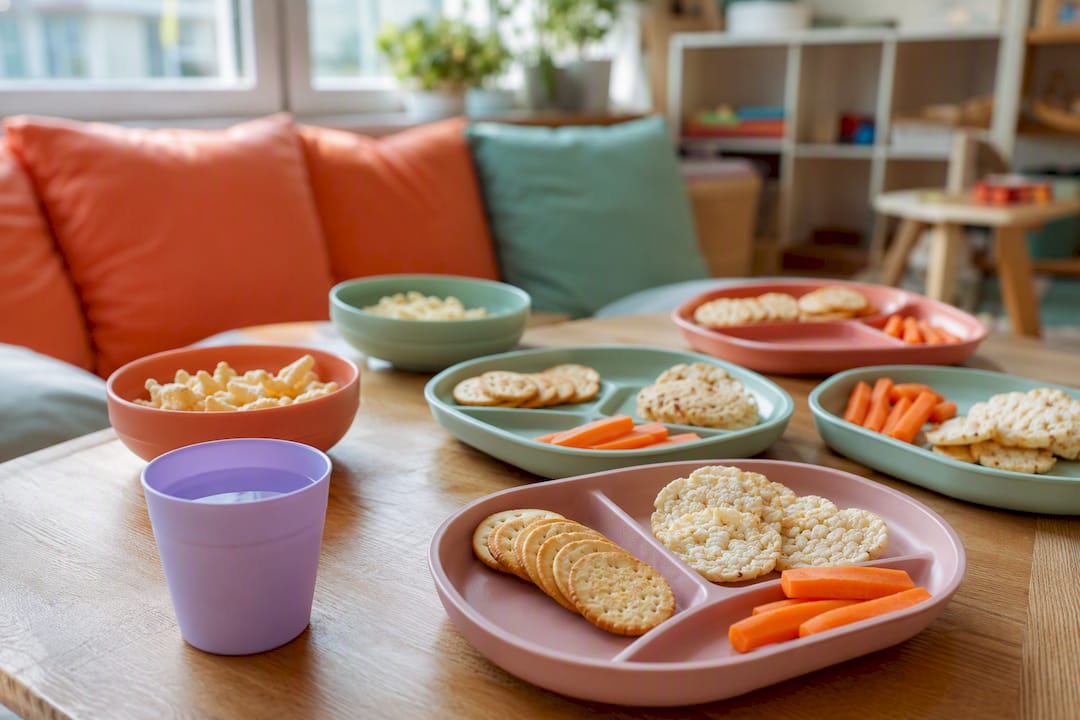
Serve familiar, pre-portioned food on compartmentalised plates at a scheduled, visible “snack time” and you’ve solved eighty per cent of the problem before a single balloon goes up. That’s it. That’s the plan.
Two more things make it work. Label every single item, clearly, so nobody has to guess or ask. And put one adult near the food table whose only job is to offer, never push, so a child can approach in their own time. This isn’t a hunch. The Child Mind Institute recommends compartmentalised plates and clear labels specifically to cut food-surprise anxiety, and They Are The Future’s party guidance puts snack time on the schedule like any other activity, not an afterthought bolted onto the end.
- Compartmentalised plate, pre-portioned, nothing touching.
- Every item labelled in plain words.
- One familiar adult offering, zero pressure, always an easy “no thanks.”
Pro Tip: Whoever serves the food should be someone the child already trusts, not a random auntie with a tray. New face plus new food is a lot to process in one go.
Table of Contents
- Setting up a picky eater party food station that stays calm
- What foods actually work for sensory-sensitive kids?
- How do I schedule food without causing a meltdown?
- Telling guests what to expect without the awkward speech
- Cake and candles without the sensory ambush
- Three menus you can copy straight onto an invite
- What SEN party food guides usually get wrong
- Sources
- FAQ
Setting up a picky eater party food station that stays calm
I remember the first party where I actually got this right. I put down a compartmentalised plate, labelled each square, and watched my son’s shoulders drop about two inches. That’s the whole point. Predictability isn’t a nice extra, it’s the mechanism.
Here’s what the food station actually needs:
- Compartmentalised plates (plastic, dishwasher safe, cheap online)
- Small visible labels on cards or laminated tags, not handwriting nobody can read
- Pre-portioned containers so nothing looks like a “help yourself” free-for-all
- A mix of utensil options, including hands-only for kids who avoid cutlery
- A drinks station, separate from food, so choices don’t get overwhelming
- A quiet seat away from the main scrum
- One helper whose only job is the food table
Keep labels short: “Plain crisps,” “Breadsticks,” “Water.” No cute names, no surprises hiding under a joke title. Position the food zone away from the music and movement, ideally in a corner or side room, echoing what Fun & Function calls a calm-down zone for the whole event, not just food.
Pro Tip: Batch-prep every labelled portion the night before. Future-you, at 9am on party day with a six-year-old asking twelve questions, will be very grateful.
What foods actually work for sensory-sensitive kids?
A child once refused an entire cake because the sponge was “wrong,” not because of taste but because the texture didn’t match what she expected from the colour. That’s not fussiness. That’s a sensory mismatch, and it’s completely fixable once you stop guessing and start matching food to what the child reliably tolerates.
Three things matter more than flavour: texture, temperature, and predictability of taste. Occupational therapy guidance points to sensory load as the real variable, meaning crunchy, smooth, and soft foods each land completely differently depending on a child’s processing profile, and most children regulate better around textures and temperatures they already know. A minority of sensory seekers actively want stronger, more intense sensations, so build in both options rather than assuming one preference fits every guest.
Familiar, simple solids: plain crackers, breadsticks, plain crisps, dry cereal.
Soft, comfort items: mashed banana, yoghurt pots, plain bread, room-temperature rice pudding.
Crunchy items: carrot sticks, apple slices, rice cakes.
Chewy, oral-seeking options: dried fruit strips, chewy sweets for kids who seek that input.
Drinks: water, diluted juice, milk or a dairy-free alternative, always in the same cup type the child uses at home if you know it.
| Common option | Sensory profile | Allergy-aware swap |
|---|---|---|
| Cheese sandwich | Soft, mild, cool | Dairy-free spread, gluten-free bread |
| Chocolate biscuits | Crunchy, sweet | Carob or allergen-free biscuit brand |
| Fruit yoghurt | Smooth, cold | Coconut or oat-based yoghurt |
| Sausage rolls | Warm, flaky | Gluten-free pastry version |
Autism Parenting Magazine’s advice is blunt on this: plan for texture, temperature and taste together, and stock gluten-free and casein-free options as standard, not as a special request handled awkwardly on the day. Keep utensils and surfaces separate for allergen swaps to avoid cross-contact.
A few firm don’ts: never mix textures on one plate (wet touching dry is a dealbreaker for many kids), avoid strong-smelling foods near the table, and skip bright artificial dyes where you can. Small choices, big difference.
How do I schedule food without causing a meltdown?
A boy I know calms the second he spots “snack time” on the wall timetable. Not because he’s hungry. Because he knows what’s coming next, and that certainty does more for regulation than any amount of coaxing.
Keep the whole party to 60 to 90 minutes and put snack time on a visual plan or social story well before the day. Include the time, who’s serving, where to sit, and what happens if a child wants to skip it entirely.
- Prep portions the morning of, not during the party.
- Assign one helper to pre-portion and one to offer.
- Cue the transition five minutes ahead with a timer or countdown.
- Use a PECS or AAC prompt if that’s part of the child’s normal communication.
- Offer food once, calmly, then step back.
Keep allergen handling with one dedicated adult who knows every guest’s needs, separate from whoever’s managing games. Zero pressure means offering, never insisting, and never commenting if a child eats nothing at all.
Pro Tip: Script the offering line in advance: “Snack’s ready if you want it.” Neutral, no eye contact required, no expectation baked in.
Telling guests what to expect without the awkward speech
I used to dread writing party invites. Too much explanation felt like an apology; too little left parents guessing and kids blindsided. The fix is short, plain wording that does the work for you.
Try this on the invite: “This is a sensory-friendly party. Food will be labelled and served on individual plates. There’s no pressure to try anything, and your child can bring their own safe snacks if that’s easier.”
For helpers supervising the table:
- Offer once, in a flat, friendly tone, then leave it.
- If a child says no, just say “That’s fine” and move on.
- Never narrate what a child is or isn’t eating, to them or to other adults.
- Let any child leave the table whenever they want.
- If a guest brings food, ask for it labelled with a full ingredient list.
Add one more line for other parents: the birthday child might not join in for cake or singing, and that’s the plan, not a shame spiral. Normalise it before anyone’s there to be surprised by it.
Cake and candles without the sensory ambush
I’ve watched a child flinch so hard at a candle flame that the whole room went quiet. Nobody meant harm. Nobody had asked him first. Ask the birthday child what they actually want, then build the ritual around that answer, not around what parties are “supposed” to look like.
Low-stimulus cake options that tend to land well:
- Individual cupcakes with plain icing, so nobody has to share a knife or wait for slicing
- Plain sponge or loaf cake, minimal decoration
- Rice pudding pots, served at room temperature
- Stacked plain biscuits instead of traditional cake altogether
Swap loud rituals for gentler ones: LED candles instead of flame, a whispered “happy birthday” instead of a full-volume chorus, or a ribbon-pull and sticker station as the celebratory moment instead. NeuroLaunch’s guidance on party planning backs individual portions and quieter ritual alternatives as standard practice, not compromises.
Keep balloons out of reach and avoid latex, and choose LED over open flame every time.
Pro Tip: Rehearse the chosen ritual in a social story beforehand, so the child knows the exact sequence before it happens live.
Three menus you can copy straight onto an invite
I’ve prepped three plates on the kitchen counter the night before more parties than I can count, and honestly, having a template ready is what keeps my own nerves down.
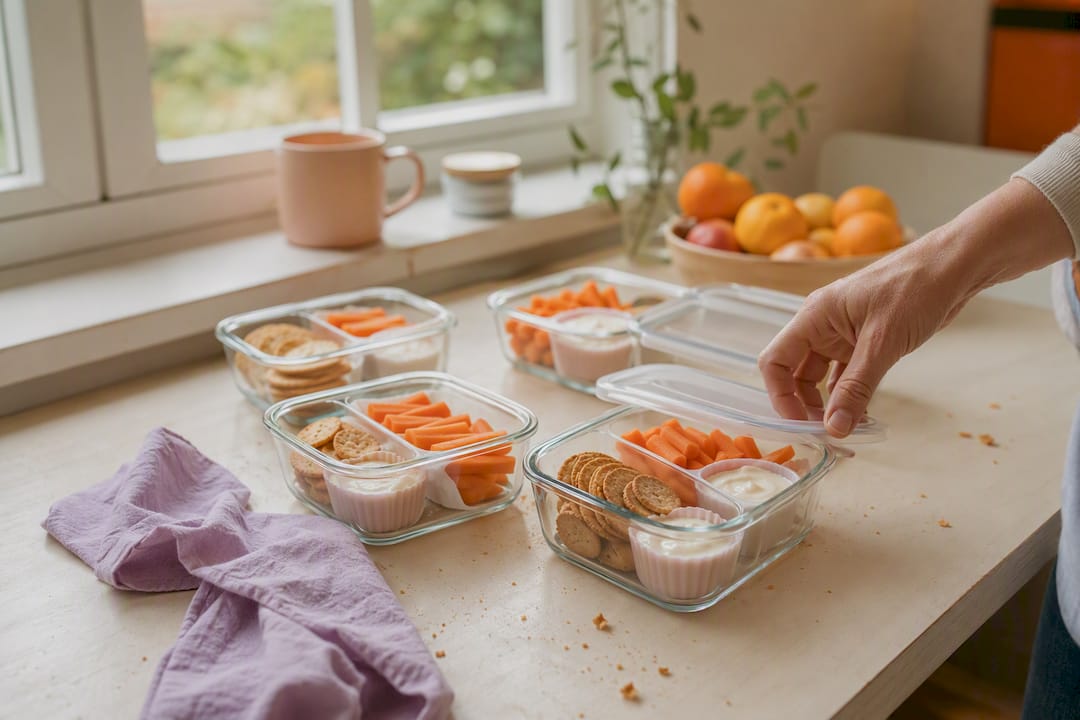
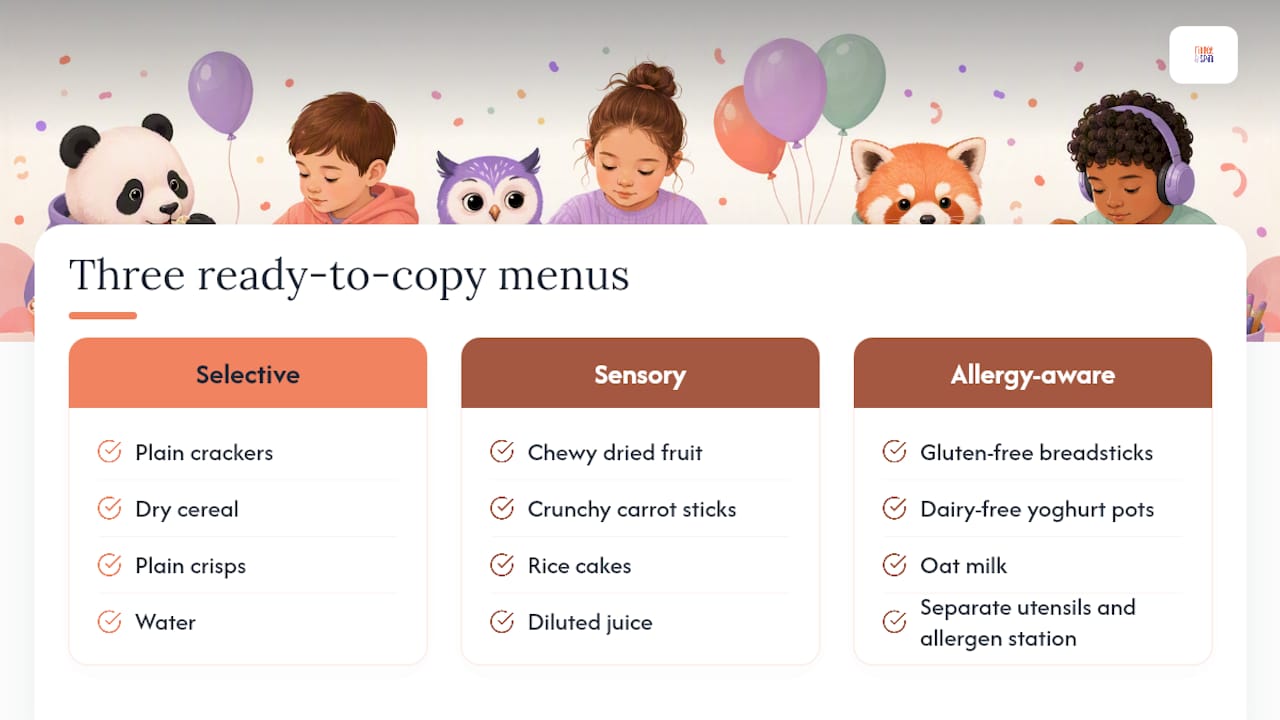
Menu 1, selective-preferring: plain crackers, dry cereal, plain crisps, water, all in individual pre-portioned pots. Prep time: 20 minutes.
Menu 2, sensory-seeker: chewy dried fruit, crunchy carrot sticks, rice cakes, diluted juice, labelled and portioned separately so intense textures don’t surprise anyone reaching blind. Prep time: 25 minutes.
Menu 3, allergy-aware: gluten-free breadsticks, dairy-free yoghurt pots, oat milk, with separate utensils and a clearly marked allergen station. Prep time: 30 minutes, plus checking every label twice.
Quick calm-down task before guests arrive: let your child help crush digestive biscuits for a no-bake pudding pot. It’s repetitive, low-pressure, and doubles as a sensory break before the noise starts.
If planning all this solo feels like too much on top of everything else, our SEN-friendly birthday party packages handle the food logistics, layout and timing for you, built by parents who’ve stood exactly where you’re standing now.
What SEN party food guides usually get wrong
Most advice out there treats picky eating as a problem to manage around the edges of a “normal” party. I think that’s backwards. The food plan isn’t a side dish to the party, it’s the structural thing holding the whole event together for a lot of neurodivergent kids.
The biggest gap I see in conventional guidance is the assumption that one clever swap, a gluten-free cupcake here, a quiet corner there, solves the day. It doesn’t. What works is layering: predictable food, a visible schedule, and genuinely zero pressure, all at once. Drop any one of those three and the other two struggle to hold.
If you take one thing from this, prioritise the schedule over the menu. A child who knows exactly when snack time happens, and knows nobody will comment if they eat nothing, copes far better with an “imperfect” food selection than a child facing a beautifully catered table with no warning it’s coming. Certainty beats variety, every single time I’ve seen it play out.
Sources
- Sensory-friendly party ideas | Child Mind Institute
- Sensory-friendly party planning (They Are The Future)
- Planning parties for kids with autism or sensory processing disorder | Autism Parenting Magazine
- Sensory birthday party ideas for autism & SPD | Fun & Function
FAQ
What is the best food for a sensory-friendly birthday party?
Familiar, plain foods your child already eats regularly work best. Serve them pre-portioned on a compartmentalised plate with clear labels, and avoid mixing textures on one plate.
How do I stop guests pressuring my child to eat?
Brief helpers in advance to offer food once and drop it if declined. A short line on the invitation, explaining the party is sensory-friendly with no pressure to try anything, prevents most awkward moments before they start.
Should I still have cake if my child won’t eat it?
Yes. Offer a low-stimulus alternative like individual cupcakes or a familiar biscuit stack, and ask your child beforehand whether they even want candles or singing, since alternatives such as LED candles reduce sensory load without losing the celebration.
How long should an SEN-friendly party last?
Keep it to 60 to 90 minutes, with food scheduled as a specific, visible slot rather than an open-ended free-for-all.
What if my child has both sensory needs and food allergies?
Use labelled, pre-portioned allergen-free swaps, gluten-free breadsticks or dairy-free yoghurt for example, and keep separate utensils and surfaces to avoid cross-contact, following the texture and temperature guidance from Autism Parenting Magazine.
Recommended
- SEN private party hire in Brighton: what actually works | Fidget and Spin Brighton
- Birthday without party ideas: practical alternatives for parents | Fidget and Spin Brighton
- SEND party venue Sussex: what actually makes one work | Fidget and Spin Brighton
- Birthday party for a non verbal child: a real guide | Fidget and Spin Brighton