
TL;DR:
- Children with sensory processing differences interpret sensory information differently, affecting their behavior and regulation. Recognizing these patterns helps tailor support, especially by emphasizing regulation through movement before addressing other sensory inputs.
Sensory processing differences describe how some children’s brains interpret and respond to sensory information in ways that are distinct from most people, affecting their daily experience, regulation, and behaviour. The formal term you may encounter is sensory integration, coined by occupational therapist Dr A. Jean Ayres. Contact UK defines sensory profiles as covering what a child seeks, avoids, needs for regulation, and how they manage movement coordination. Understanding this isn’t a diagnosis tick-box exercise. It’s the foundation for actually helping your child. Whether your little one melts down at the sound of a hand dryer or hurls themselves at every sofa cushion in the room, there’s a reason. And it’s not naughtiness.
What are the common sensory processing differences in children?
Sensory processing differences show up in four main patterns, and most children with sensory integration issues sit across more than one. Knowing which pattern fits your child changes everything about how you respond.

Over-responsiveness means the nervous system reacts too strongly to sensory input. A child might cover their ears at normal noise levels, refuse certain food textures, or become distressed by clothing tags. What looks like a tantrum about a sock seam is actually a genuine pain response.
Under-responsiveness is the opposite. The child needs more input to register sensation at all. Sensory seeking behaviours like crashing into furniture, chewing everything, or spinning without dizziness are classic signs. These children aren’t being reckless. They’re trying to feel regulated.
Sensory discrimination difficulties mean the brain struggles to interpret what type of sensation it’s receiving. A child might not notice they’ve hurt themselves, confuse hot and cold, or find it hard to identify objects by touch alone. It looks like carelessness. It isn’t.
Praxis challenges affect movement planning and coordination. Buttons, stairs, catching a ball, knowing where their body is in space — these tasks take enormous effort. UCLA Health notes that sensory processing disorder is not yet an official standalone diagnosis, but the functional impact on daily life is what matters most.
- Covers ears or becomes distressed by everyday sounds
- Refuses certain food textures, temperatures, or smells
- Seeks crashing, spinning, or heavy pressure constantly
- Appears clumsy or struggles with buttons, zips, and stairs
- Doesn’t notice pain or injury in the way you’d expect
- Becomes overwhelmed in busy, bright, or noisy environments
Pro Tip: Keep a brief daily note on your phone for one week. Log what triggered a meltdown or a seeking behaviour, what time of day it happened, and what helped. Patterns emerge faster than you’d think.
Which sensory systems are involved in sensory integration?
Most people learn about five senses in school. Children with sensory integration issues are actually navigating eight, and the three that get the least attention are often the most important for regulation.
- Tactile (touch): Skin receptors process texture, pressure, temperature, and pain. Over-sensitivity here drives clothing refusals and difficulty with messy play.
- Auditory (hearing): Processes sound volume, pitch, and direction. Many autistic and ADHD children experience auditory over-responsiveness in busy environments.
- Visual (sight): Processes light, movement, and visual clutter. Fluorescent lighting and busy wallpaper genuinely affect some children’s ability to focus.
- Olfactory (smell): Smell is processed directly by the limbic system, which governs emotion. Strong smells can trigger immediate distress responses.
- Gustatory (taste): Closely linked to smell and texture. Restricted eating in many autistic children is rooted in genuine sensory aversion, not fussiness.
- Vestibular (movement and balance): Sensors in the inner ear detect head position and movement. This system is central to regulation and attention.
- Proprioceptive (body position): Receptors in muscles and joints tell the brain where the body is in space. Children who seek heavy work, like carrying bags or pushing furniture, are often regulating through this system.
- Interoception (internal body signals): This sense tells us we’re hungry, thirsty, hot, or anxious. Shriners Children’s highlights interoception as critical for regulation and one of the most overlooked systems in early support.
The vestibular and proprioceptive systems deserve particular attention. They underpin a child’s ability to sit still, pay attention, and feel calm. A child who can’t regulate through movement will struggle to access learning or social connection. This is why sensory support starting with movement before tackling harder inputs is so effective.
Pro Tip: If your child seeks spinning, crashing, or heavy lifting, try offering ten minutes of intentional proprioceptive input before a challenging activity. Think wall push-ups, carrying a weighted bag, or jumping on a trampoline. It’s not a cure. It’s a warm-up.
How can parents identify their child’s sensory profile?
A sensory profile is a map of your child’s sensory world. It shows which systems are over-responsive, under-responsive, or struggling with discrimination, and it tells you where to focus support. You don’t need a formal assessment to start building one, though an occupational therapist can help you go deeper.
The key is watching for three things: frequency, intensity, and impact. A child who occasionally dislikes loud music has a preference. A child who cannot enter a supermarket without a meltdown has a processing difference that affects daily life. UCLA’s Dr Lauren Waldron emphasises that functional disruption, specifically the impact on mealtimes, sleep, and socialisation, is what distinguishes a processing difference from a simple preference.
- Note which environments consistently cause distress or dysregulation
- Record which sensory inputs your child actively seeks out
- Observe whether meltdowns follow a pattern (time of day, specific triggers)
- Notice what calms your child: deep pressure, movement, quiet, dim light
- Track how sensory challenges affect eating, sleeping, and social situations
Contact UK recommends hypothesising which category your child falls into, whether under-responsive, discriminatory difficulties, or praxis challenges, and targeting supports from there. Formal sensory questionnaires, like the Sensory Profile 2 developed by Winnie Dunn, can give you a structured framework if you want something more systematic. Your child’s occupational therapist or SENCO can guide you to the right tool.
What practical strategies help children with sensory challenges?
The most effective support starts with the child’s profile, not a generic list of tips. Contact UK advises building a sensory regulation routine that provides just enough input to help a child feel calm and ready, rather than forcing them through difficult sensory experiences unprepared.
Matching strategies to sensory patterns
| Sensory pattern | Helpful strategies |
|---|---|
| Over-responsive (tactile) | Seamless clothing, advance warning before touch, firm pressure rather than light touch |
| Over-responsive (auditory) | Ear defenders, noise-reducing headphones, quiet transition spaces |
| Under-responsive (proprioceptive) | Heavy work activities, weighted blankets, resistance play like pushing and pulling |
| Under-responsive (vestibular) | Swinging, spinning, rocking, bouncing on a trampoline |
| Discrimination difficulties | Consistent routines, labelled environments, clear visual cues |
| Praxis challenges | Breaking tasks into small steps, physical guidance, extra practice time without pressure |
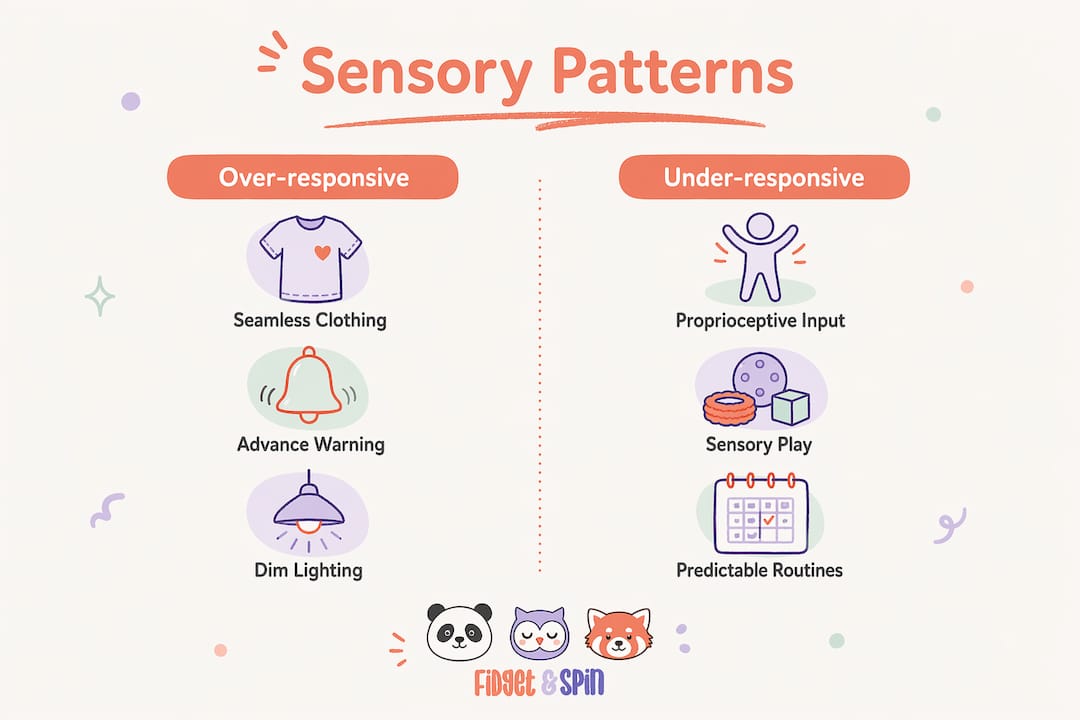
Environmental modifications matter as much as direct strategies. Dim lighting, reduced visual clutter, and predictable routines all lower the sensory load before a child even walks into a room. Sensory zone ideas for neurodiverse children can help you think about how to adapt spaces at home.
Sensory play is one of the most accessible tools parents have. Sand, water, playdough, and kinetic sand offer tactile input that children can control. Swings, climbing frames, and obstacle courses provide vestibular and proprioceptive input in a way that feels like fun rather than therapy. The OT and play-based support approach combines both, which is why it works so well for children with sensory integration issues.
Punishment never helps. A child who is dysregulated cannot choose to behave differently in that moment. Contact UK is clear that sensory processing differences are not intentional misbehaviour. They are distinct sensory-system profiles that need environmental support, not consequences.
How do sensory differences affect social development?
Sensory overload and social situations are a difficult combination. A birthday party with balloons, shouting, and an unfamiliar venue is a sensory assault course for many children with sensory sensitivities. The result is often a child who withdraws, melts down, or refuses to attend, which parents then have to explain to well-meaning relatives. (We’ve all been there.)
The connection between sensory processing and social development is direct. A child who is dysregulated cannot read social cues, take turns, or manage the unpredictability of peer interaction. Getting regulation right first is what makes social participation possible.
- Prepare children for social events with visual schedules and social stories
- Identify a quiet exit space at any venue before the event starts
- Use co-regulation: stay physically close, use a calm voice, offer deep pressure if helpful
- Keep early social experiences short and low-stimulus, then build gradually
- Celebrate small wins. Staying for twenty minutes is a genuine success.
Group activities for SEN children work best when the environment is designed with sensory needs in mind from the start, rather than adapted as an afterthought. Sensory-friendly sessions, where noise levels are managed, lighting is considered, and children can move freely, remove the barriers that make mainstream groups so hard.
Key takeaways
Understanding a child’s sensory profile is the most effective starting point for reducing dysregulation and supporting social and sensory development.
| Point | Details |
|---|---|
| Sensory profiles vary widely | Children may be over-responsive, under-responsive, or face discrimination and praxis difficulties across different systems. |
| Eight senses, not five | Vestibular, proprioceptive, and interoceptive systems are central to regulation and are often overlooked. |
| Function matters more than labels | The impact on daily life, mealtimes, sleep, and socialisation, is what guides support decisions. |
| Match strategies to the profile | Generic fixes rarely work. Tailor supports to the specific sensory systems involved. |
| Regulation before socialisation | A child who is dysregulated cannot access social connection. Sensory regulation comes first. |
What I’ve learnt from parenting Remy
When Remy was small, I thought I was failing. He’d last ten minutes at a toddler group before something, a squeaky toy, a stranger touching his arm, the smell of someone’s lunch, would tip him into complete overwhelm. I’d carry him out, red-faced, while other children sat in a circle singing Wheels on the Bus. I didn’t have the language for what was happening. I just knew something was.
Learning about sensory profiles changed how I saw him entirely. The crashing into walls wasn’t aggression. The food refusals weren’t manipulation. The screaming in the supermarket wasn’t a performance. His nervous system was working overtime, all day, every day. Once I understood that, I stopped trying to fix his behaviour and started trying to understand his sensory world.
The hardest part isn’t the meltdowns. It’s the isolation. The feeling that every mainstream space was designed for a child who isn’t yours. That’s why Anthony and I built Fidget and Spin. Not because we had all the answers, but because we were tired of leaving early.
If you’re reading this at midnight after a hard day, I want you to know: you are not failing. You are learning a language most people never have to learn. And that knowledge, once you have it, is genuinely life-changing.
— Caitlin
Sensory play sessions designed for children like yours
Fidget and Spin runs weekly sensory stay-and-play sessions in Brighton and Hove for neurodiverse children aged 1–6. Every session is built around three zones: Wiggle & Bounce for big movement, Snuggle & Chill for low-stimulus rest, and Squish & Squeeze for tactile play and fidgets. There are no expectations, no circle time, and no side-eye.
Parents tell us the sessions feel like the first place their child has ever just… played. If you’re ready to try a space that was built with your child in mind, book a sensory play session and see how our sessions work. We also offer SEN-friendly birthday parties across Brighton, Hove, and wider Sussex, because every child deserves a party that doesn’t end in tears before the cake.
FAQ
What are sensory processing differences in children?
Sensory processing differences mean a child’s brain interprets sensory input in a unique way, sometimes needing more or less stimulation to feel calm and regulated. Contact UK describes sensory profiles as covering what children seek, avoid, and need for regulation and coordination.
Is sensory processing disorder an official diagnosis?
Sensory processing disorder is not currently recognised as a standalone diagnosis in the DSM-5 or ICD-11. UCLA Health advises focusing on the functional impact on daily life rather than the label, as this guides more useful support.
How do I know if my child has sensory processing differences?
Watch for patterns of distress or seeking behaviour that affect daily activities like eating, sleeping, dressing, or socialising. If sensory responses are frequent, intense, and disruptive to everyday life, speak to your GP or request an occupational therapy referral.
Which professionals can help with child sensory challenges?
Occupational therapists are the primary specialists for sensory integration issues in children. Your child’s SENCO, paediatrician, or GP can refer you, and many areas also have early years SEN support teams who can advise on strategies in nursery and school settings.
Can sensory processing differences improve over time?
Many children develop better regulation strategies as they grow, particularly with targeted support and a sensory-aware environment. Early intervention through sensory integration strategies and occupational therapy gives children the best foundation for managing their sensory world.
Recommended
- Sensory integration strategies: a step-by-step guide | Fidget and Spin Brighton
- Top sensory resources 2025: a parent’s practical guide | Fidget and Spin Brighton
- Engaging kids in sensory play: a practical guide for neurodiverse families | Fidget and Spin Brighton
- Sensory play best practices for neurodiverse kids | Fidget and Spin Brighton