
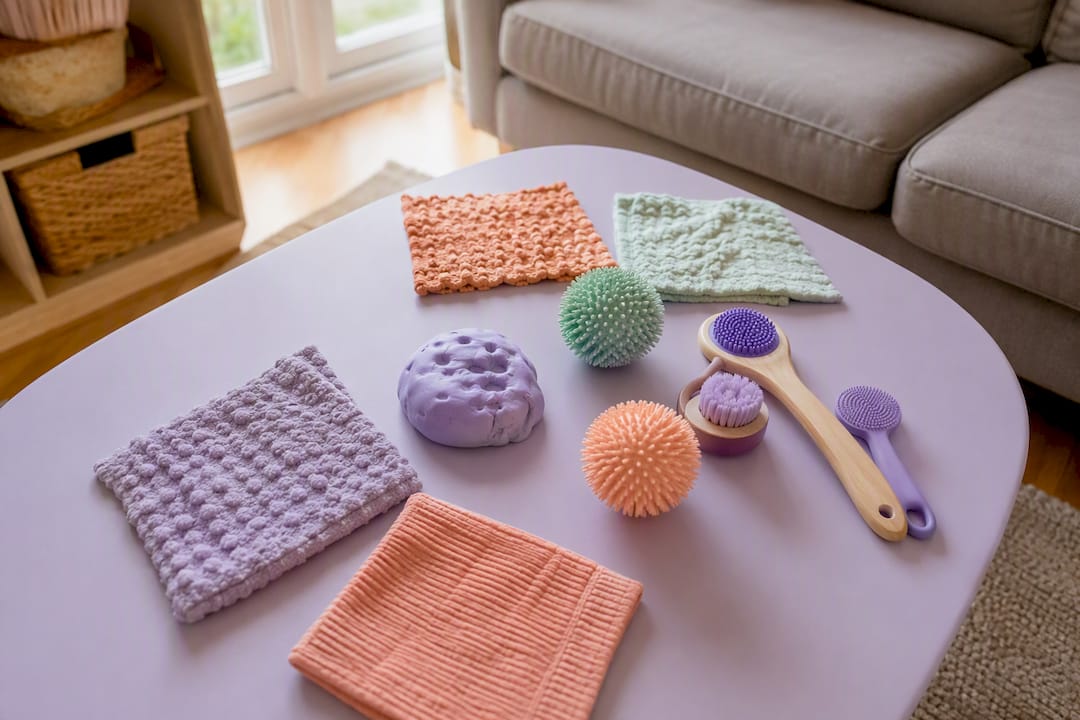
Try firm, predictable pressure first, and give your child a choice about how touch happens. That’s the single most useful thing to do when light touch causes distress, and it’s the one I reach for before anything else, in sessions and at home with Remy.
A few things to try this week:
- Start with some “heavy work” before any touch-heavy activity, such as wall push-ups, a bear hug, or carrying a weighty object.
- Swap tagless, seamless clothing in for anything scratchy or stiff.
- Use a paintbrush or soft mitt for messy play instead of bare hands, so contact stays predictable.
Systematic reviews consistently find deep pressure has the strongest evidence base for calming the nervous system in the short term, ahead of most other single-tool tactics. Watch your child’s face and body. If they tense, pull away, or go quiet in that particular way you learn to read, stop. This isn’t about pushing through.
Key Takeaways
Deep pressure delivered predictably, paired with caregiver training, has the strongest evidence for easing tactile defensiveness, while single-tool fixes and rigid protocols show weaker, less consistent results.
| Point | Details |
|---|---|
| Lead with deep pressure | Firm, predictable contact calms the nervous system faster than light touch or surprise contact. |
| Track in threes | Log each attempt and judge a strategy over three tries, not one good or bad day. |
| Adjust the environment first | Small changes, positioning, clothing, tools, often unlock participation without any confrontation. |
| Know the referral triggers | Ask for an OT assessment if touch is disrupting feeding, sleep, or school attendance. |
| Practise somewhere safe | Fidget and Spin’s three sensory zones let children build tolerance through choice, not pressure to perform. |
This article is general information, not a substitute for advice from a qualified doctor. Consult a qualified healthcare professional about your own circumstances before acting on anything here.
Table of Contents
- What the evidence says about tactile defensiveness strategies
- A short sensory routine to try before touch-heavy events
- Small changes at home and school that can help lower tactile triggers
- When to ask for an OT assessment or extra support
- How we run sessions and what worked for our child
- Bringing siblings and friends into tactile play, gently
- Sources
- FAQ
What the evidence says about tactile defensiveness strategies
Tactile defensiveness isn’t naughtiness, and it isn’t a phase. It’s a recognised sensory processing difference, often seen alongside autism and ADHD, and sensory features are written into the diagnostic criteria for ASD. Light, unexpected touch can trigger a genuine alarm response. Firm, deep pressure tends to do the opposite: it calms the sympathetic nervous system (the one shouting “danger”) and nudges the parasympathetic system (the one saying “you’re safe”) into gear.
That’s not a guess. Physiological studies show measurably different tactile processing in the brains of autistic and ADHD children, which is why a light tap that means nothing to one child can feel like an electric shock to another.
The best evidence for a caregiver-delivered approach comes from Qigong Sensory Treatment, a structured parent-led massage protocol. Trials report reduced tactile abnormalities, better sleep, and even lower parenting stress after consistent use, though it’s worth being honest: many of these studies are small, and bias risk is a real limitation.
The active ingredient in these programmes isn’t the exact technique. It’s parental consistency, training, and attunement to the child’s own cues.
Broader reviews back this up: deep pressure and caregiver training show the strongest and most consistent results, while single-system tools used alone tend to produce mixed outcomes.
Pro Tip: Weighted vests are often discussed for attention and focus, but the evidence supporting them is limited. Avoid relying solely on one gadget.
A short sensory routine to try before touch-heavy events
Haircuts, dentist visits, school photo day. You know the ones that make your stomach drop days in advance. A short routine, run the same way each time, gives your child something predictable to hold onto.
- Spot the trigger. Is it the brush, the bib, the queue, the stranger’s hands? Pick one thing to change first.
- Do five to ten minutes of heavy work beforehand. Wall push-ups, carrying a weighted laundry bag, firm squeezes through a blanket burrito.
- Introduce the touch predictably. Approach from the front, use firm pressure rather than a light brush, offer a tool (a brush or mitt) as a stepping stone, and agree a stop signal in advance, a hand up, a word, a card.
- Log it, briefly. One line after each try: what happened, what you’d change. Give it three attempts before deciding whether it’s working.
Pro Tip: Our guide to sensory play best practices has more on building requested, predictable touch into everyday play, not just the scary events.
Small changes at home and school that can help lower tactile triggers
A peg at the end of the row instead of the middle. Standing at the back of the queue instead of getting jostled in the thick of it. These sound like nothing. They’re not nothing.
Practical adjustments that can genuinely help and usually cost little or nothing:
- Tagless, seamless clothing, and letting your child pick fabric themselves.
- Positioning: end of the line, edge of the carpet, chair against the wall.
- Brushes, mitts, or gloves offered as a choice for messy or wet play.
- Consistent hair-care tools and a warning before the first touch, every time.
When you talk to schools, borrow the language multi-agency toolkits use: naming the specific trigger, describing a graduated response, and asking for a person-centred sensory plan rather than a blanket exemption. NHS-aligned guidance frames this as identify, calm, adapt, review, which is a far easier conversation to have with a SENCO than “he just doesn’t like it.”
When to ask for an OT assessment or extra support
If tactile defensiveness is stopping meals, sleep, or school attendance, or you’re seeing regression, it’s time to ask for help, not push through alone.
- Ask your GP or school SENCO for an occupational therapy referral.
- An OT assessment maps your child’s full sensory profile, not just touch, and gives you specific strategies plus caregiver training.
- Bring a few logged examples from your routine tracking. It speeds things up enormously.
- While you wait, keep the small home routines going. They’re not a placeholder; they’re part of the plan.
How we run sessions and what worked for our child
I used to leave baby groups early. Every time. Pack the bag before we’d even arrived properly, just in case. That dread doesn’t fully go away, but it does get quieter.
At Fidget and Spin, we built three zones on purpose: Wiggle and Bounce for big movement, Snuggle and Chill for low-stim recovery, Squish and Squeeze for tactile play. Every tactile activity is offered, never forced, with a brush or mitt sitting right next to the mess so nobody has to touch anything they haven’t chosen to, respecting participant dignity and consent as outlined in our Participant dignity in media: NDIS and allied health guide.
- We say “hands or brush?” before every messy tray. Always. Every child, every time.
- We warn before we touch, even for something as small as helping with a zip.
Pro Tip: If you’re planning your own version at home, our sensory play best practices guide covers how we structure choice into play without it turning into a negotiation marathon.
Bringing siblings and friends into tactile play, gently
Siblings get dragged into all of this too, often without anyone asking if they mind. Your youngest wants to hold hands in the queue. Your child can’t. That’s a real thing to navigate, not just an inconvenience to smooth over.
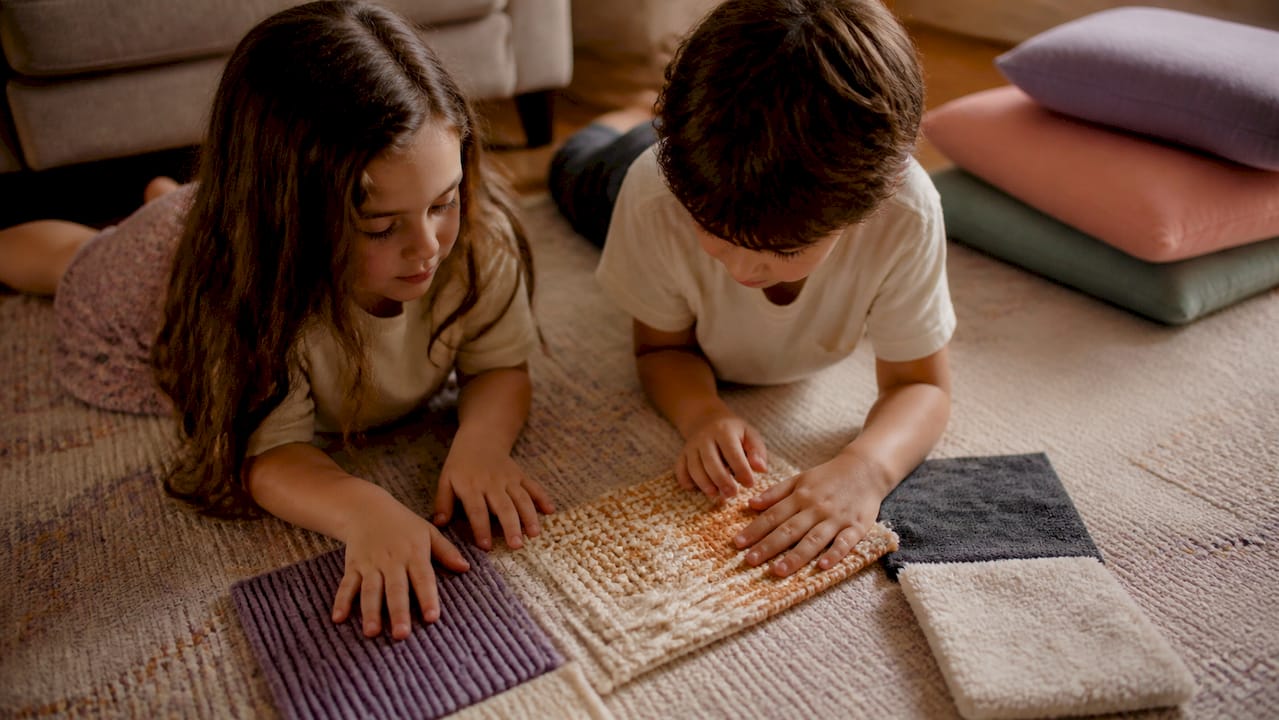
Give siblings and peers a job that doesn’t rely on touch: passing the paintbrush, choosing the next texture from a tray, holding up the stop card if your child asks them to. It keeps them included in the activity without making touch the price of entry.
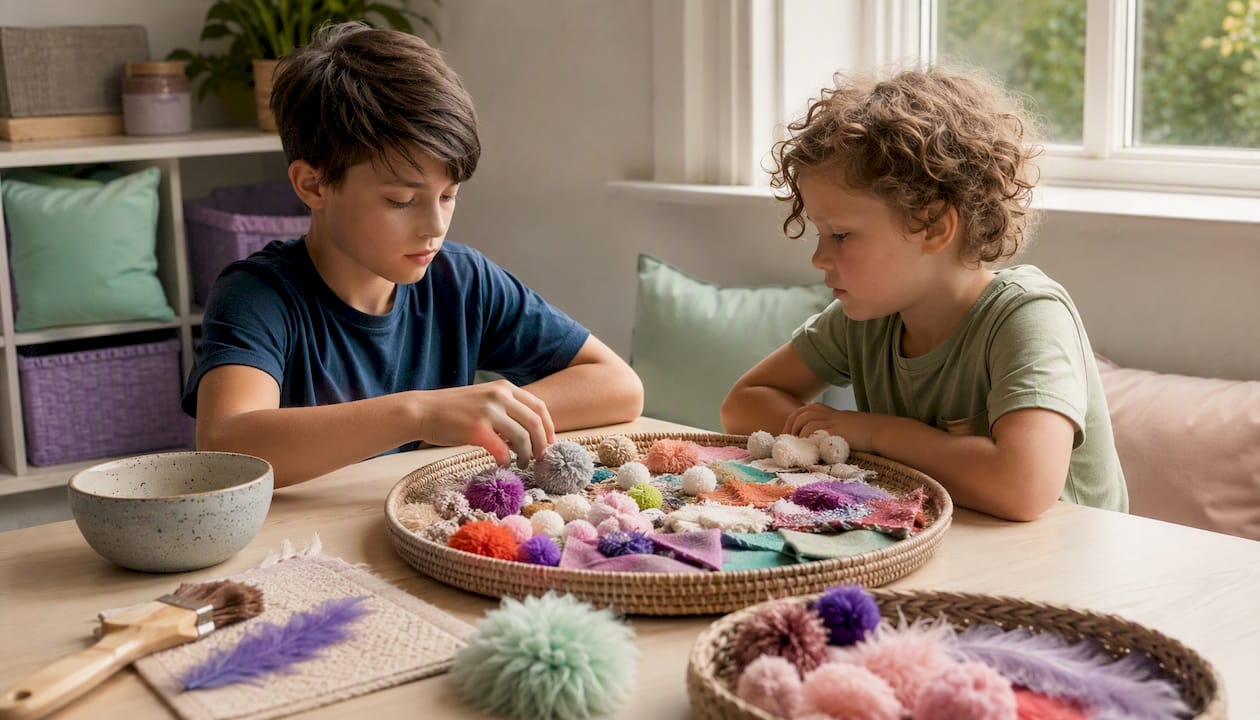
Talk to siblings plainly, at whatever level suits their age. “Their skin feels things more than yours does, it’s not about you” tends to land better than a long explanation. Some of the calmest tactile play I’ve seen in our sessions has been a sibling matching their pace exactly, brush for brush, without being told to.
Peers benefit from the same low-key modelling. Children copy what adults do without fanfare far more readily than they follow an instruction. When another child sees an adult offer a mitt instead of insisting on bare hands, they usually just… offer the mitt too, next time, to their own friend. No lecture required.
The bit nobody tells you at the start
I still remember standing outside a soft play centre, watching Remy through the glass, deciding whether to go in or turn around and go home. Some days you turn around. Setbacks aren’t failure, they’re data. Progress here is rarely a straight line, but it is real.
— Caitlin
A safe space to practise, without the side-eye
Fidget and Spin is the alternative to hoping a mainstream party or playgroup will somehow work out this time. Our weekly sensory sessions run across three zones, Wiggle and Bounce, Snuggle and Chill, and Squish and Squeeze, so your child can approach tactile play at their own pace, with brushes and choice built in from the start, not bolted on as an afterthought.

Families come to us for exactly the reasons in this article: a space where firm, predictable touch is the default, where nobody stares if a child needs to leave the tray and go quiet in the corner, and where staff already know what a stop signal looks like. It works just as well for a Tuesday morning session as it does for a birthday. Our SEN-friendly party packages run across Brighton, Hove and wider Sussex, with private venue hire and the same three zones on offer. Find out how our sessions work or check availability for sensory birthday parties in Brighton and book a taster session this week.
Sources
- Interventions targeting sensory challenges in children with ASD — PMC
- Early intervention with a parent-delivered massage protocol decreases severity of autism — Wiley
FAQ
How can tactile defensiveness be managed?
The best-supported approach combines firm, predictable deep pressure, caregiver-delivered massage routines, and small environmental changes, ideally with caregiver training rather than a single gadget or technique.
Do people with ADHD have tactile defensiveness?
Yes. Tactile processing differences appear in both autism and ADHD, and research shows altered cortical responses to touch relate to core symptoms in both conditions.
What triggers tactile defensiveness?
Common triggers include unexpected light touch, certain fabric textures, messy or wet play, and unpredictable contact from other people, though the exact trigger varies a great deal from child to child.
Is tactile defensiveness a mental disorder?
No. It’s a sensory processing difference, not a mental disorder, though sensory features are included among the diagnostic criteria for ASD and it can occur alongside other conditions.
Recommended
- Effective sensory play strategies for neurodiverse kids | Fidget and Spin Brighton
- Sensory regulation activities for toddlers: a real guide | Fidget and Spin Brighton
- Sensory integration strategies: a step-by-step guide | Fidget and Spin Brighton
- Promoting gentle social interaction for neurodiverse kids | Fidget and Spin Brighton