TL;DR:
- Sensory processing describes how a child’s brain interprets input from eight sensory systems and responds accordingly. Differences can lead to hypersensitivity or hyposensitivity, affecting daily activities like play, eating, and dressing. Practical strategies include environmental tweaks and child-controlled activities to support participation and regulation.
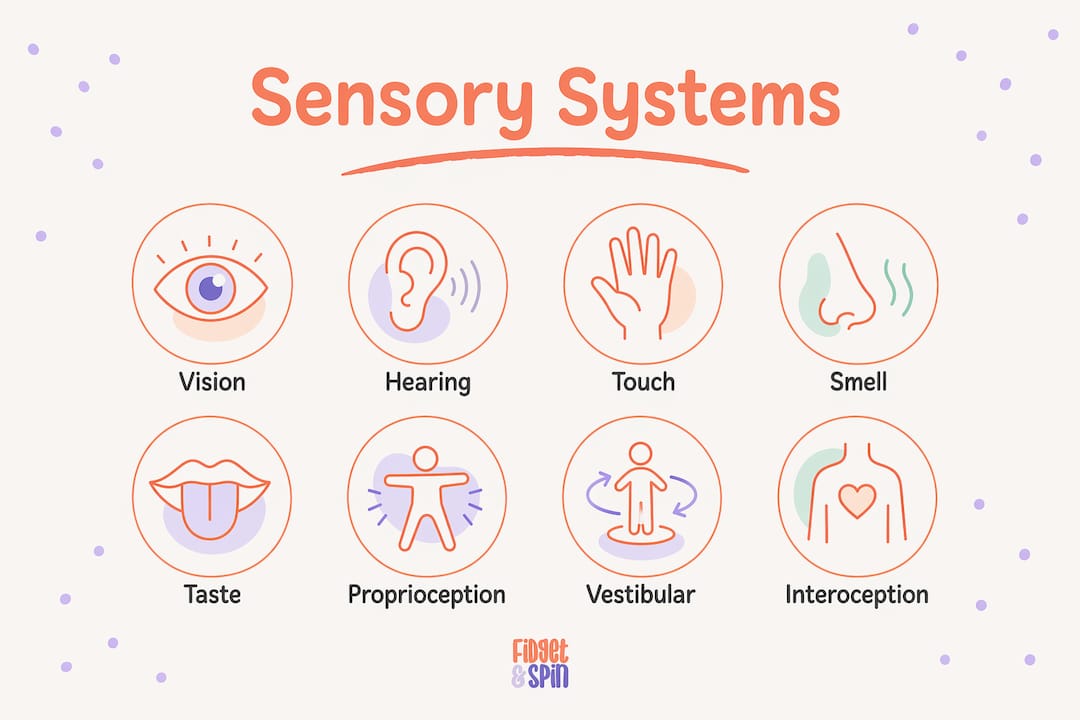
Sensory skills, or sensory processing, describe how your child’s brain takes in information from eight sensory systems, makes sense of it, and decides how to respond. When Remy was small, he’d clap his hands over his ears in the supermarket before I’d even registered the background music. That wasn’t a tantrum. That was his brain doing exactly what brains do, just with a much lower threshold for sound. Sheffield Children’s NHS describes sensory processing as “the way that our body takes in and makes sense of information” across hearing, vision, touch, taste, smell, vestibular, proprioception, and interoception. These eight systems work together every single day, shaping how your child eats, dresses, plays, and copes at a party.
TL;DR:
- Sensory processing = how the brain receives and responds to input from eight sensory systems.
- It affects participation in everyday life: play, mealtimes, dressing, outings, and birthday parties.
Table of Contents
- What are sensory skills? The eight systems your child uses every day
- How sensory processing differences show up at home, nursery, and parties
- Practical strategies you can try today, before you see an OT
- What a Fidget and Spin session actually looks like
- When to seek professional help and what to ask for
- Key takeaways
- A note from me, Caitlin
- Fidget and Spin: sensory sessions and SEN parties in Brighton, Hove and Sussex
- FAQ
- Where I checked this: trusted UK sources
What are sensory skills? The eight systems your child uses every day
A child who refuses bright lights at nursery and another who sprints laps around the living room are both showing you their sensory systems at work. Each of the eight senses feeds the brain a different kind of information, and differences in any one of them can shape behaviour in ways that look puzzling until you know what you’re looking at.
| Sense | What it tells the brain | Everyday example |
|---|---|---|
| Vision | Light, colour, movement, depth | Squinting or distress under fluorescent lights |
| Hearing | Volume, pitch, direction of sound | Covering ears at a hand dryer or crowded café |
| Touch | Texture, pressure, temperature, pain | Refusing certain clothing fabrics or labels |
| Smell | Odour intensity and type | Gagging at food smells before tasting anything |
| Taste | Flavour, texture in the mouth | Eating only a narrow range of foods |
| Proprioception | Body position and muscle effort | Crashing into furniture; seeking tight hugs |
| Vestibular | Balance and movement through space | Spinning constantly; fear of swings |
| Interoception | Internal signals: hunger, thirst, toileting need | Not noticing they need the loo until it’s urgent |
The Bridgewater NHS children’s OT materials use the concept of thresholds to explain this: some children have a low threshold (they notice everything, fast) and some have a high threshold (they need a lot of input before they register it). Neither is wrong. Both are just how that child’s brain is wired. For a deeper look at sensory play explained. Our Brighton-based guide walks through what this looks like in practice.
How sensory processing differences show up at home, nursery, and parties
We left soft play early so many times I stopped booking it. The noise, the unpredictability, the other children shrieking with joy in a way that felt like an alarm to Remy. I used to think I was doing something wrong. I wasn’t. He was hypersensitive to sound and touch, and soft play is basically a sensory assault course.
Hypersensitivity (over-responsive) means the brain reacts strongly to input that others barely notice:
- Covering ears at ordinary noise levels, or distress at hand dryers and hoovers.
- Refusing clothes with seams, labels, or certain fabrics.
- Gagging at food textures or smells, or being unable to sit near certain foods.
Hyposensitivity (under-responsive / sensory seeking) means the brain needs more input to register a sensation:
- Chewing sleeves, pencils, or non-food items throughout the day.
- Crashing into walls, furniture, or other children to feel where their body is.
- Not noticing cuts, bruises, or extreme temperatures.
Many neurodiverse children show both patterns at once, perhaps seeking proprioceptive input (crashing, squeezing) while being hypersensitive to sound. NHS and National Autistic Society guidance frames these mixed presentations as common in autism and ADHD, not unusual edge cases. One child, multiple patterns, all of it real.

Practical strategies you can try today, before you see an OT
After a noisy school pick-up, Remy used to arrive home completely dysregulated. We started doing ten minutes of heavy work in the hallway before anything else: carrying his bag up the stairs twice, pressing his palms flat against the wall. It cost nothing and it changed the whole evening.
You don’t need a referral to try these. They’re drawn from sensory-based approaches recommended by the Royal College of Occupational Therapists, adapted for everyday family life.
Quick environment tweaks:
- Swap overhead lights for a lamp with a warm bulb in the main play area.
- Use a visual schedule (pictures or symbols) so your child knows what’s coming next.
- Offer a predictable arrival ritual before parties or sessions: same route, same first activity.
- Give a “quiet zone” option at home: a corner with a weighted blanket and low light.
A simple sensory diet across the day:
- Morning: jumping on a mini trampoline or star jumps (vestibular); carrying a heavy bag or books (proprioceptive).
- Midday: playdough or kinetic sand (tactile); chewy snacks like dried mango or bagels (oral).
- Before bed: dim lamp, gentle compression (a firm hug or weighted blanket), calm visual like a lava lamp.
For outings:
- Pack ear defenders and let your child put them on before you enter, not after it’s already too much.
- Agree a safe route and a quiet exit point before you go in.
- Use a transitional object (a familiar toy or fidget) to carry from home into the new space.
- Teach your child to ask for a break using whatever communication works for them: words, PECS, AAC, a hand signal.
Pro Tip: Let your child choose the intensity and timing of sensory activities. Research on self-selected sensory exposure shows that when children control the input, they engage more positively and regulate more effectively. Forced input often backfires. For more ideas, our post on screen-free activities has practical options that work well alongside a sensory routine.
What a Fidget and Spin session actually looks like
The first time we ran a session, I turned up braced for chaos. Remy walked straight past the big movement area and climbed into the cosy corner. He stayed there for twenty minutes, calm, absorbed, on his own terms. That was the moment I knew the zone design mattered.
Fidget and Spin’s weekly stay-and-play sessions for children aged 1–6 are built around three distinct sensory zones, because one environment cannot meet every child’s needs at once:
- Wiggle & Bounce: big movement, jumping, rolling, spinning. Vestibular and proprioceptive input for children who seek it.
- Snuggle & Chill: low lighting, soft textures, cosy corners. A genuinely calm space, not just a quieter version of the main room.
- Squish & Squeeze: tactile play, playdough, fidgets, sensory bins. Hands-on exploration at the child’s own pace.
Children move between zones freely. There’s no timetable pressure, no expectation to join in, no side-eye if your child needs to leave early. The RCOT March 2026 guidance is clear that sensory support should prioritise participation in meaningful activities, not symptom reduction. That’s exactly the frame we use.
For SEN-friendly birthday parties (ages 1–7 across Brighton, Hove and Sussex), we use a flexible timeline, quieter games, a predictable schedule shared in advance, and the same zone structure. When you book, tell us your child’s sensory profile and any arrival needs. We’ll build the session around them. See our post on creative sensory zone ideas if you want to try replicating zones at home.
When to seek professional help and what to ask for
Some children need more than environmental tweaks. If your child can’t tolerate clothing well enough to get dressed for school, or won’t sit at the table for any meal, that’s a functional impact worth taking seriously.
NHS OT services typically accept sensory referrals when differences significantly affect two or more everyday occupations: dressing, eating, sleep, school attendance, or safety. Start with your GP or your child’s school SENCO.
Who can help:
- GP: can refer to community paediatrics or NHS OT; ask specifically for a referral citing functional impact.
- School SENCO: can request an OT assessment through the SEND pathway and put interim support in place.
- Paediatric OT: assesses sensory strengths and differences and their impact on daily activities; no specific diagnosis required.
Questions to take to your appointment:
- “Which everyday activities are most affected, and how?”
- “Can we set participation-focused goals rather than symptom-reduction targets?”
- “Is a time-limited sensory plan appropriate, and how will we measure whether it’s working?”
- “What can we do at home and school between sessions?”
The RCOT guidance is explicit: goals should prioritise meaningful occupational outcomes. If an OT is measuring success only by changes in sensory symptoms rather than whether your child can now eat at the table or attend school, it’s fair to ask why.
Key takeaways
Sensory processing differences are how the brain responds to eight sensory systems, and they affect every part of a child’s day, from getting dressed to attending a party.
| Point | Details |
|---|---|
| Eight sensory systems | Vision, hearing, touch, smell, taste, proprioception, vestibular, and interoception all shape daily participation. |
| Hyper vs hyposensitivity | Over-responsive children avoid input; under-responsive children seek it. Many neurodiverse children show both patterns. |
| Try these today | Visual schedule, heavy work before transitions, ear defenders on arrival, child-chosen sensory activity at each part of the day. |
| When to seek help | Ask your GP or SENCO for a referral when sensory differences affect two or more everyday occupations. |
| Local option | Fidget and Spin runs weekly sensory sessions (ages 1–6) and SEN-friendly parties (ages 1–7) across Brighton, Hove and Sussex. |
A note from me, Caitlin
The dread before a birthday party. I know it. The mental checklist: will there be a balloon popper, will the music be too loud, will another parent give me that look when Remy bolts for the exit. I spent a long time trying to prepare him for the world as it was. It took longer to realise the world could also change a bit.
What actually helped us was autonomy and predictability. Letting Remy choose whether to wear ear defenders rather than insisting. Giving him the schedule in pictures the night before. Letting him leave a room without it being a failure. The Beyond Autism guidance frames aids like ear defenders the same way you’d frame glasses: tools that enable access, not crutches that create dependency. That reframe changed how I thought about the whole thing.
Simple strategies at home make a real difference. And when you want a space where none of this needs explaining, where the room is already built for your child, that’s what Fidget and Spin is for.
Fidget and Spin: sensory sessions and SEN parties in Brighton, Hove and Sussex
You walk in. Someone greets you at the door who already knows this might be your child’s first time in a new space. There’s no pressure to join in, no expectation to perform. Your child looks around, spots the cosy corner, and heads straight for it.
Fidget and Spin offers weekly sensory stay-and-play sessions for neurodiverse children aged 1–6, across three sensory zones in Brighton and Hove. We also run SEN-friendly birthday parties for ages 1–7 across Brighton, Hove and wider Sussex, with private venue hire and a flexible setup designed around your child’s needs.
| What | Starting price |
|---|---|
| Weekly sensory session | Book via sessions page |
Concession spots are available, supported by Pay-It-Forward donations at checkout. When you book, tell us your child’s sensory profile and any arrival needs. We’ll do the rest. Head to our sessions page to check dates, or our parties page to see what each package includes.
FAQ
What are sensory skills in simple terms?
Sensory skills, or sensory processing, describe how the brain takes in information from eight sensory systems and decides how to respond. Differences in this process affect how a child participates in everyday activities like eating, dressing, and play.
How do I know if my child has sensory processing differences?
Look for patterns across daily life: consistent distress around specific textures, sounds, or lights; seeking intense physical input like crashing or chewing; or difficulty with transitions and unpredictable environments. If these affect two or more everyday activities, speak to your GP or school SENCO.
Is sensory processing disorder an official diagnosis in the UK?
No. As Sheffield Children’s NHS notes, Sensory Processing Disorder is not recognised as an independent diagnosis in the UK. Services focus on functional impact rather than a specific label.
What sensory activities can I try at home today?
Heavy work (carrying books, wall press-ups), tactile play (playdough, kinetic sand), and a predictable visual schedule are all low-cost starting points. Let your child choose the activity and control how long they do it.
What makes Fidget and Spin different from mainstream play sessions?
Fidget and Spin is built specifically for neurodiverse children, with three distinct sensory zones, no expectation to join in, and staff who understand sensory needs. Sessions run weekly in Brighton and Hove; SEN-friendly parties are available across Sussex.
Where I checked this: trusted UK sources
- Sheffield Children’s NHS Foundation Trust: sensory processing difficulties — parent-friendly overview of all eight systems and practical strategies.
- Royal College of Occupational Therapists: informed view on sensory integration therapy (March 2026) — guidance on participation-focused goals and time-limited interventions; worth printing for OT appointments.
- Just One Norfolk NHS: sensory processing differences — clear explanation of hyper/hyposensitivity in autism and ADHD.
- Black Country Children’s NHS: sensory differences information — useful on referral thresholds and functional impact criteria.
- Bridgewater NHS: children’s OT senses script — plain-language descriptions of each sense; good to share with school staff.
- Beyond Autism: guidance on equipment and supports — practical framing of aids as access tools.
- MDPI: multisensory environment pilot study — evidence on self-selected sensory exposure and engagement outcomes.
- Fidget and Spin: sensory processing differences in children — local parent-centred guide for further reading.
Recommended
- What is sensory play? a guide for SEN families | Fidget and Spin Brighton
- Sensory integration strategies: a step-by-step guide | Fidget and Spin Brighton
- Top sensory resources 2025: a parent’s practical guide | Fidget and Spin Brighton
- Sensory processing differences in children: a parent’s guide | Fidget and Spin Brighton