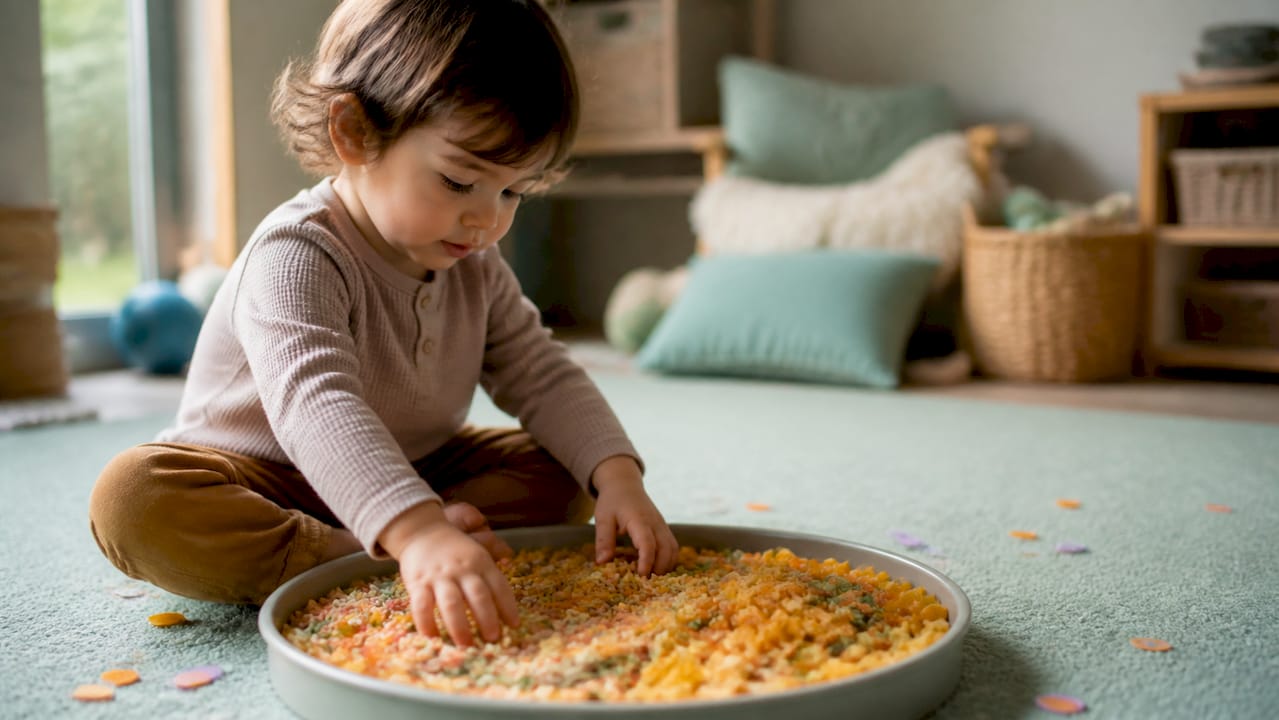
You can set up creative sensory play in ten minutes with things already in your kitchen. That matters, because sensory play supports regulation, fine motor development, and language — and you do not need a therapy room or a Pinterest-perfect setup to make it happen.
Here are eight ideas you can start today:
- Sensory tray with dried pasta or lentils — hide small toys inside for digging and scooping. Choking risk: supervise closely under 3s; avoid small pasta shapes with babies.
- Water play in a washing-up bowl — add cups, spoons, and a drop of food colouring. Safe from birth with supervision; never leave unattended.
- Scented playdough — shop-bought or homemade (recipe below). Check for wheat/gluten allergies; avoid for under 18 months without supervision.
- Sound shakers — fill small sealed bottles with rice, buttons, or dried peas. Seal lids with tape; choking risk if opened by under 3s.
- Coloured rice tray — dye rice with food colouring and vinegar, dry overnight. Non-toxic colouring only; supervise under 3s.
- Bubble wrap stamping — roll paint over bubble wrap and press onto paper. Non-toxic paint only; babies can do this with hands.
- Ice cube exploration — freeze small toys or flowers in ice, let children melt them with warm water. Supervise under 3s; avoid small frozen objects.
- Soap foam play — whisk washing-up liquid with a little water. Avoid near eyes; not suitable for children with skin sensitivities without a patch test.
Key takeaways
A parent setting a tray of coloured rice in front of a toddler is already doing the most important thing: creating the conditions for regulation, language, and connection through play.
| Point | Details |
|---|---|
| Start simple, start today | Eight activities need only kitchen materials and ten minutes of setup time. |
| Sensory play builds real skills | Fine motor, language, attention, and emotional regulation all benefit from regular, varied sensory input. |
| Follow the child, not the plan | Observe first; adapt activities to what the child seeks or avoids rather than repeating a fixed plan. |
| Neurodiversity-aware setup matters | Separate low-stim and high-intensity zones, offer clear exit points, and model co-play without directing. |
| Fidget and Spin offers local support | Weekly sessions and SEN-friendly parties in Brighton, Hove, and Sussex for neurodiverse children aged 1–5. |
Table of Contents
- Why creative sensory play actually works
- Sensory activities for kids, organised by sense
- Easy at-home recipes and materials
- How to set up a session, keep it safe, and clean up without drama
- Adapting sensory play for neurodiverse children
- Three ready-to-run session plans by age
- What I have actually learned running these sessions
- Fidget and Spin sessions and SEN-friendly parties in Brighton & Hove
- Sources
- FAQ
Why creative sensory play actually works
Picture a two-year-old who arrived at a session wound tight, refusing to take her coat off. Within five minutes of sitting beside a tray of warm kinetic sand, her shoulders dropped. She hadn’t been asked to do anything. She just started pressing her palm in, slowly, watching the shape it left.
That is regulation happening in real time. And it is exactly what the evidence describes.
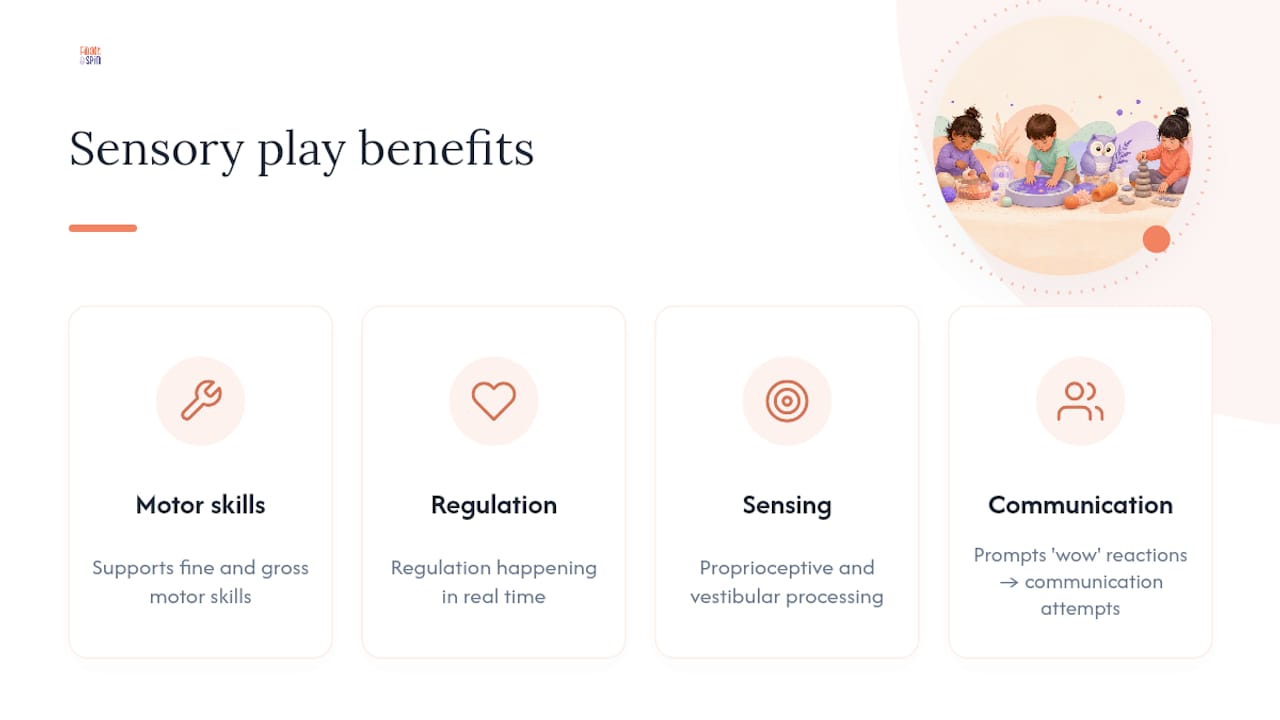
Sensory play supports fine and gross motor skills, attention, emotional regulation, language development, and proprioceptive and vestibular processing. For neurodiverse children in particular, the Seashell Trust notes that tactile and movement activities can prompt “wow” reactions that lead directly to communication attempts — a low-pressure route into interaction that structured activities rarely offer.
NHS guidance recommends varied sensory experiences from birth, including messy play, water play, finger painting, and cooking alongside children. The message is consistent: repeated, everyday sensory input builds the neural pathways children need for learning and self-regulation.
One thing worth saying clearly: sensory play at home is not the same as Sensory Integration Therapy (ASI). The RCOT’s March 2026 guidance is explicit that clinical ASI should not be attempted at home without professional guidance. What parents and educators can do is observe, model, and create conditions for play. That is enough. That is, in fact, the recommended approach.
Sensory activities for kids, organised by sense
Touch
A child pressing both hands into a tray of cold, wet sand and going very still — that is tactile processing at work.
- Cloud dough (flour and oil): squeezes and crumbles, satisfying for seekers. Wheat allergy risk; use rice flour as an alternative.
- Kinetic sand in a tray with spoons and moulds.
- Shaving foam spread on a tray — draw patterns with fingers. Not for children with skin sensitivities.
- Textured fabric squares: velvet, hessian, faux fur, smooth satin — sort by feel.
- Playdough with embedded objects (buttons, pebbles, dried pasta) to find by touch.
- Finger painting directly on a table surface. Non-toxic paint; wipe-clean surface.
- Wet and dry rice side by side in a split tray — compare textures.
Age tweaks: Babies explore with mouths, so keep materials large and food-safe. Toddlers love digging and filling. Children aged 3–5 enjoy hiding objects and guessing by touch alone.
Sight
- Sensory bottles filled with glitter, water beads, or oil and water — shake and watch. Seal lids with superglue; not for under 3s unsupervised.
- Light table or a tablet screen under a clear tray of coloured water.
- Colour mixing with pipettes and small pots of water dyed with food colouring.
- Torch play in a darkened room with coloured cellophane over the beam.
- Bubble play outdoors — chase, pop, observe.
- Kaleidoscope or prism exploration near a window.
Sound
- Homemade shakers (rice, buttons, dried peas in sealed bottles).
- Drumming on pots and pans with wooden spoons.
- Listening walk outdoors — pause, close eyes, name what you hear.
- Musical freeze: play music, stop, freeze. Toddlers love this; it also builds body awareness.
- Rain sticks made from cardboard tubes and dried rice.
Smell
- Scented playdough: add lavender, peppermint, or orange essential oil. Patch test; avoid strong scents for sensory-sensitive children.
- Herb garden exploration: crush rosemary, mint, or lemon balm leaves.
- Smell jars: small pots with cotton wool soaked in vanilla, coffee, or citrus.
- Baking together — the smell of bread or biscuits is itself a sensory experience.
Taste (optional, supervised)
Food play is a legitimate sensory activity, but it is always optional and always supervised. Never pressure a child to taste anything.
- Jelly exploration: wobble, squish, poke. Gelatine or vegan alternatives; check for dietary restrictions.
- Fruit and vegetable tasting tray: textures, colours, smells, and tastes together.
- Ice lolly making: pour juice into moulds, freeze, explore the cold and the drip.
Always check for allergies and dietary requirements before food-based play.
Proprioception (body awareness)
- Wheelbarrow walking, rolling in a blanket, or crawling through a tunnel.
- Heavy work: carrying a small backpack with a water bottle inside, pushing a laundry basket.
- Playdough squeezing, rolling, and pounding — this is proprioceptive input, not just fine motor.
- Jumping on a small trampoline or cushions on the floor.
Vestibular (movement and balance)
- Swinging in a garden swing or a blanket held by two adults.
- Spinning slowly on a swivel chair (watch for dizziness; some children are highly sensitive).
- Rocking on a rocking horse or balance board.
- Rough-and-tumble play on a soft mat.
Easy at-home recipes and materials
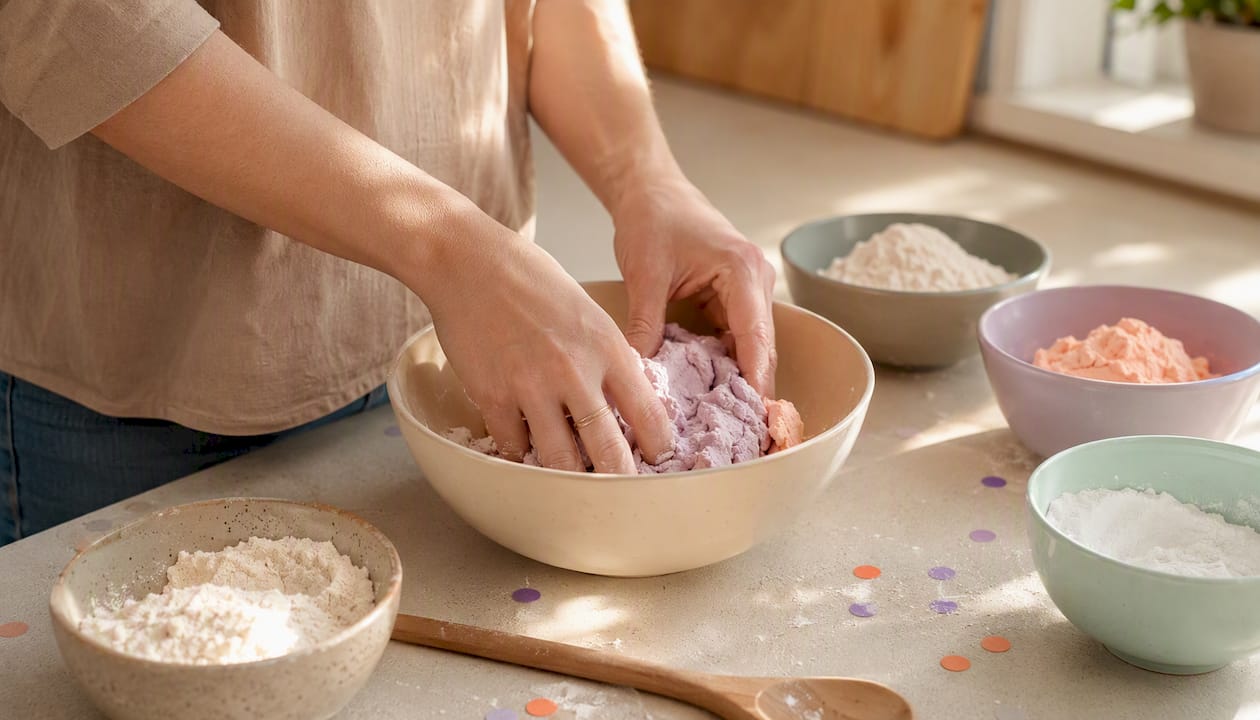
Mixing a batch of playdough on a Sunday afternoon is one of those small acts that pays back all week. Here are the recipes I use most.
Basic playdough
Ingredients: 2 cups plain flour, 1 cup salt, 2 tbsp cream of tartar, 2 tbsp vegetable oil, 1.5 cups boiling water, food colouring (optional).
Method: Mix dry ingredients. Add oil and boiling water (adult only for the hot water step). Stir quickly, then knead until smooth. Add colouring during kneading.
Storage: Airtight container or zip-lock bag. Shelf life: 2–3 months at room temperature. Allergy note: Contains wheat and salt. Not suitable for unsupervised under-18-month-olds.
The NDNA notes that adults modelling vocabulary during playdough play — naming textures, actions, and shapes — measurably supports language development and exploratory behaviour.
Gloop (oobleck / cornflour mix)
Ingredients: 2 cups cornflour, 1 cup water, food colouring (optional).
Method: Pour cornflour into a bowl. Add water gradually, stirring. It should feel solid when pressed and liquid when left still. Add colouring to the water first.
Storage: Covered bowl in the fridge. Shelf life: 2–3 days. Note: Cornflour is gluten-free. Dispose of down the drain with plenty of water; do not pour undiluted gloop down the sink.
NHS guidance recommends gloop specifically and advises letting children explore fully before cleaning up — resist the urge to wipe hands mid-play.
Coloured rice
Ingredients: 500g uncooked white rice, 2 tbsp white wine vinegar, food colouring.
Method: Mix rice, vinegar, and colouring in a zip-lock bag. Shake well. Spread on a baking tray and dry for 1–2 hours (or overnight). Make several colours.
Storage: Airtight jars or containers. Shelf life: Several months. Note: Supervise under 3s; rice is a choking risk.
Sensory bottle
Ingredients: Clean plastic bottle with secure lid, water, glitter glue, small plastic beads or sequins, a drop of washing-up liquid (slows the glitter).
Method: Fill bottle three-quarters full with warm water. Add glitter glue and decorations. Seal lid with superglue. Allow to dry fully before giving to a child.
Storage: Indefinite if sealed. Note: Never give an unsealed sensory bottle to a child under 3.
Soap foam
Ingredients: 3 tbsp washing-up liquid, 1 tbsp water.
Method: Whisk with a hand whisk or electric mixer until stiff peaks form. Serve in a tray.
Storage: Use immediately; does not keep. Note: Not suitable for children with eczema or broken skin without a patch test.
How to set up a session, keep it safe, and clean up without drama
I used to dread the cleanup more than the activity itself. Then I started laying a shower curtain on the floor first, and suddenly the whole thing felt manageable.
Setup checklist:
- Lay a shower curtain, old sheet, or newspaper under the play area.
- Set up one or two activities maximum — more is rarely better.
- Have a damp cloth and a bin bag within reach before you start.
- Offer ear defenders if sound play is involved; have a quiet corner or pop-up tent available.
- Use a visual timer (a sand timer or a simple app) so children know when the session ends.
- Keep a small first-aid kit nearby for any skin reactions.
Session length by age:
- 0–12 months: 10–15 minutes maximum; follow their cues closely.
- 1–2 years: 15–20 minutes; expect frequent switches between activities.
- 3–5 years: 20–30 minutes; they can sustain focus longer but still need an exit option.
Watch for signs of overstimulation: flushing, covering ears or eyes, pulling away, increased vocalisations, or sudden stillness. These are signals to slow down or stop, not to push through.
Choking and allergy guidance for under 3s: Avoid small items (buttons, beads, coins, small pasta shapes). Use food-safe materials only. Check for nut, wheat, and latex allergies before any food-based or natural-material play. The Early Years Sensory Awareness Toolkit stresses that sensory needs are dynamic: what works one day may not work the next, so observe and adapt rather than repeating a plan that is not landing.
For more on sensory play best practices in home and early years settings, including risk and cleaning guidance, the Fidget and Spin resource library covers this in detail.
Adapting sensory play for neurodiverse children
Remy once spent an entire session watching from inside a pop-up tent. He did not touch a single tray. And that was a good session. He was regulating. He was watching. He was choosing.
The one-line answer: follow the child, prioritise choice, and model without expectation.
Concrete adaptations:
- Offer a low-stim zone (dim lighting, soft textures, quiet) alongside a higher-intensity zone. Cardiff University’s sensory room research confirms that separating “wiggle” and “chill” spaces — even with just a blanket and a tent — makes a measurable difference.
- Give children control: offer two choices (“rice tray or water?”), not an open-ended “what do you want to do?”
- Build in clear exit points. A child who knows they can leave without consequence is far more likely to stay.
- Use visual schedules or choice boards (PECS-style picture cards work well) to show what is coming and what comes next.
- For AAC users, have their device or communication board within reach during play — sensory experiences are rich prompts for new vocabulary.
- Model co-play: sit beside the child, engage with the same material, narrate what you are doing. Do not direct. Do not ask questions. Just play.
The RCOT’s 2026 guidance is clear that sensory-based interventions at home should be time-limited and clearly defined, with caregivers coached in modelling rather than attempting clinical Sensory Integration Therapy independently. The goal is not to replicate an OT session. It is to create the conditions where a child can self-regulate and explore.
Pro Tip: Start with five minutes of observation before joining the play. Watch what the child gravitates towards, what they avoid, and how their body looks. That five minutes tells you more than any assessment form.
For deeper reading on OT and play-based support for neurodiverse children, including how to work alongside an occupational therapist at home, that resource is worth bookmarking.
Three ready-to-run session plans by age
1. Baby session (0–12 months), 10–15 minutes
She is lying on her back, batting at a foil sheet taped to the underside of a low table. Her eyes are wide. She has no idea what it is. That is the point.
Goal: Sensory exploration, visual tracking, early tactile input.
- 0–3 min: Lay baby on a soft mat. Offer a foil sheet or crinkle fabric to touch and look at.
- 3–8 min: Water play in a shallow tray (2cm deep maximum). Support baby’s hands in the water. Narrate: “cold,” “splash,” “wet.”
- 8–12 min: Gentle massage with a small amount of baby-safe lotion. Name body parts. Sing softly.
Safety: Never leave unattended near water. All materials must be large enough that they cannot be swallowed.
2. Toddler session (12 months–3 years), 20–25 minutes
He has tipped the entire rice tray onto the floor within thirty seconds. This is not a failure. This is proprioceptive input and cause-and-effect learning happening simultaneously.
Goal: Fine motor, language, emotional regulation.
- 0–5 min: Coloured rice tray with spoons, cups, and small containers. Model filling and pouring; name colours and actions.
- 5–15 min: Playdough with rollers, cutters, and natural objects (leaves, sticks, pebbles). Sit alongside and play. Narrate without directing.
- 15–20 min: Bubble wrap stamping with non-toxic paint. Let them press, roll, and explore freely.
- 20–25 min: Wind-down: warm water in a bowl with a cloth for hands. Slow, quiet, predictable.
Safety: Supervise throughout; remove small objects for children who still mouth materials.
3. Early years small group session (3–5 years), 30–40 minutes
Four children, three trays, one adult per zone. The noise level is joyful. One child is in the tent. That is fine.
Goal: Language, social play, gross and fine motor, regulation.
- 0–5 min: Arrival and choice: show two or three activity options with picture cards. Children choose their starting zone.
- 5–15 min: Gloop station (cornflour mix) with tools and small world figures. Adults model vocabulary: “squelch,” “solid,” “liquid,” “pour.”
- 15–25 min: Sensory tray rotation: one tray of kinetic sand, one of water with pipettes and colour mixing, one of textured fabric and sorting.
- 25–35 min: Movement break: jumping, rolling, wheelbarrow walking on a soft mat.
- 35–40 min: Calm-down: sensory bottles to shake and watch, quiet music, dim lighting in a cosy corner.
Safety: One adult per zone minimum. Visual timer visible to all children. Exit route clearly available.
What I have actually learned running these sessions
I remember the first birthday party we ever ran. I was convinced something would go wrong. A child would melt down, a parent would look horrified, the playdough would be too dry. I had contingency plans for my contingency plans.
What actually happened: a six-year-old autistic boy who had never made it through a birthday party before sat at the gloop table for forty minutes. His mum cried. I cried. Anthony pretended not to cry.
The thing I have learned, running Fidget and Spin sessions week after week, is that the activity matters far less than the conditions. A child who feels safe, who has an exit, who is not being watched with that particular brand of hopeful adult anxiety — that child will usually find their way to something. It might take the whole session. It might take three sessions. That is fine.
I have also learned that parents need permission to leave early. Not because they have failed, but because reading your child’s cues and acting on them is the most skilled thing you can do in that room. We built our sessions around that. Flexible arrival, flexible exit, no side-eye. The real impact of sensory play is rarely visible in the moment. It accumulates.
Fidget and Spin sessions and SEN-friendly parties in Brighton & Hove
Anthony and I run three sensory zones every week in Brighton: Wiggle & Bounce for big movement, Snuggle & Chill for low-stim cosy time, and Squish & Squeeze for tactile play and fidgets. Every session is staffed by people who understand processing differences, not just child development in the abstract.
Families who book get small group sizes, flexible arrival and exit, sensory-aware staff, and a space where nobody is going to give you a look when your child tips the rice tray. We also have Pay-It-Forward concession spots for families who need them, funded by other families at checkout.
For birthdays, our SEN-friendly party packages run from £220 to £530 and cover Brighton, Hove, and wider Sussex. No loud music, no overwhelming party games, no pressure. Just a space built for your child.
Find out how our sessions work and check current availability. If you have questions before booking, drop us a message — we are parents first, and we will give you a straight answer.
Sources
I check these resources when I plan sessions and when parents ask me for something to read that is not overwhelming.
- RCOT guidance - Using sensory integration therapy with children and young people (March 2026)
- Fun ways to play - Buckinghamshire Healthcare NHS Trust
- How do Sensory Activities help Autism? | Seashell
- Early Years Sensory Awareness Toolkit (EPUT)
- Nature inspired playdough exploration | NDNA
FAQ
What are some creative sensory play ideas you can set up quickly?
Coloured rice trays, gloop (cornflour and water), scented playdough, water play with cups and spoons, bubble wrap stamping, and sound shakers made from sealed bottles all take under ten minutes to set up using household materials.
What counts as creative play for young children?
Creative play includes any open-ended activity where a child explores materials, makes choices, and uses imagination without a fixed outcome — sensory trays, playdough, painting, water play, and small world play all qualify.
What are good sensory activities for children with processing differences?
Activities that offer choice and a clear exit point work best: a split tray with two textures, a low-stim cosy corner alongside a movement zone, or co-play with playdough where an adult models without directing. The RCOT’s 2026 guidance recommends time-limited, clearly defined activities with caregiver modelling rather than structured clinical exercises at home.
What are fun five-senses activities for young children?
Touch: playdough or kinetic sand. Sight: glitter sensory bottles or colour mixing with pipettes. Sound: homemade shakers or drumming on pots. Smell: scented playdough with lavender or orange oil. Taste (optional, supervised): a fruit tasting tray or jelly exploration. Fidget and Spin’s weekly sessions in Brighton cover all of these across dedicated sensory zones.
How long should a sensory play session last?
Babies benefit from 10–15 minutes, toddlers from 15–20 minutes, and children aged 3–5 can sustain 20–30 minutes. Always follow the child’s cues and offer an exit before signs of overstimulation appear.
Recommended
- Sensory activities: a practical guide for parents and carers | Fidget and Spin Brighton
- Sensory play best practices for neurodiverse children | Fidget and Spin Brighton
- Effective early years play strategies for neurodiverse children | Fidget and Spin Brighton
- Creative sensory zone ideas for neurodiverse children | Fidget and Spin Brighton