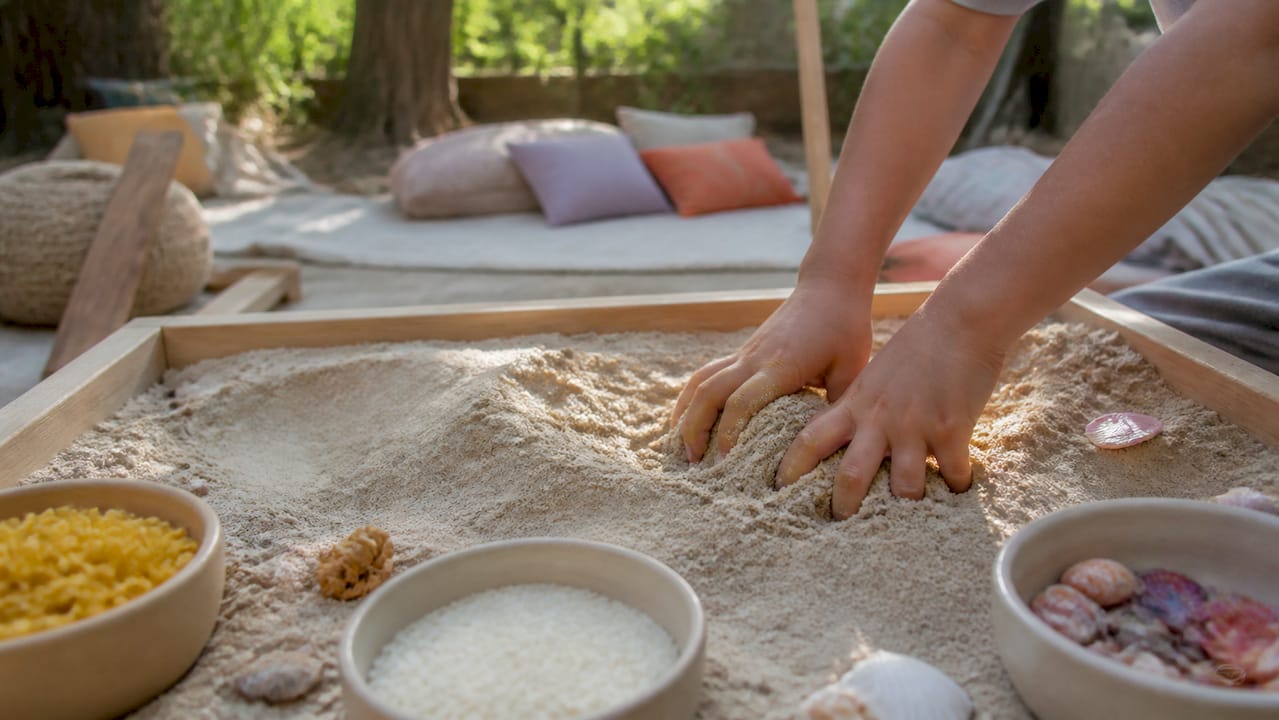
Sensory activities are everyday experiences that stimulate one or more of a child’s senses, helping them process the world, regulate their nervous system, and build motor and language skills. Here are six you can try right now, with things you probably already have:
- Dried pasta tray — pour into a baking tray and let them dig, pour, and sort (calming)
- Soapy water play — washing-up bowl, a drop of fairy liquid, a few cups (calming)
- Flour tray — spread flour on a tray and draw patterns with a finger (calming)
- Bubble wrap stomping — lay a sheet on the floor and jump (alerting)
- Sound tubes — fill empty toilet rolls with rice or lentils and seal the ends (alerting)
- Ice cube exploration — a few ice cubes in a bowl with warm water alongside (alerting/calming)
Safety first: always supervise closely, check for choking hazards with children under three, confirm no food allergies before using edible materials, and test water temperature before play.
Key takeaways
Sensory activities support regulation, motor skills, and daily participation most effectively when they are short, regular, child-led, and matched to a child’s sensory profile.
| Point | Details |
|---|---|
| Start with household items | Rice, pasta, water, and flour trays provide effective sensory input without specialist equipment. |
| Match input to need | Use calming activities (heavy work, rocking, dim light) after high stimulation; use alerting activities (jumping, crunchy food) when a child is sluggish. |
| Safety first, always | Check for choking hazards, food allergies, and water temperature; supervise closely and replace food-based materials after each session. |
| Seek OT support when daily life is affected | If sensory differences consistently disrupt eating, sleeping, or safety, speak to your GP or SENCO about an occupational therapy referral. |
| Fidget and Spin offers structured sensory sessions | Weekly stay-and-play sessions in Brighton and Hove and SEN-friendly birthday parties across Sussex are available for neurodiverse children aged 1–7. |
Table of Contents
- What sensory activities do and the eight senses they target
- Why sensory activities help: benefits parents actually notice
- Practical sensory activities grouped by sense
- How to set up sensory play at home: trays, zones, and what you actually need
- When to use calming or alerting activities and how to build a simple sensory diet
- Adapting activities for different sensory profiles and staying safe
- Outdoor and nature sensory activities and how to make them accessible
- When to ask for professional support and which UK services can help
- How I run sensory sessions: what actually happens at Fidget and Spin
- A short note from me, parent to parent
- Sensory sessions and SEN-friendly parties with Fidget and Spin
- Sources
- FAQ
What sensory activities do and the eight senses they target
Picture a child who has been bouncing off the walls all morning. You hand them a ball of playdough. Within two minutes, they are quiet, pressing and squeezing, shoulders dropping. That is sensory input doing its job.
Sensory activities are structured or free-play experiences designed to engage the senses in ways that support a child’s development. They build neural pathways for learning, strengthen motor skills, develop language, and, crucially, help children learn to regulate their own nervous systems. For neurodivergent children, those pathways often need more deliberate, repeated input to consolidate.
Most people think of five senses. NHS guidance on sensory processing identifies eight, and understanding all of them changes how you design activities:
- Vision — tracking lights, colour sorting, watching bubbles float
- Hearing — listening walks, shakers, music with a strong beat
- Touch (tactile) — playdough, sand, textured fabrics, water
- Taste — exploring food textures, temperatures, mild flavours
- Smell — scented playdough, herbs from the garden, citrus peel
- Proprioception — heavy work like pushing a trolley, carrying a bag of books, wall push-ups
- Vestibular — swinging, spinning, rolling, rocking
- Interoception — noticing hunger, thirst, heartbeat, breathing; yoga-style body-check activities
Sense UK notes that sensory play is about accessibility, not correction. The goal is never to fix a child’s sensory system. It is to give them experiences that feel safe and interesting on their own terms.
Why sensory activities help: benefits parents actually notice
I remember the first time Remy sat through an entire meal without leaving the table. He was four. We had spent three weeks doing tactile play with different food textures before they ever went near his plate. It was not magic. It was repetition and patience, and it worked.
The EPUT Early Years Sensory Awareness Toolkit recommends embedding movement and simple sensory supports into daily routines to support sleep, feeding, and everyday tasks. That matches what I see in our sessions every week.
Here is what parents most often tell me they notice after a few weeks of regular sensory play:
- Calmer transitions — children who have had proprioceptive input (heavy work, pushing, carrying) move between activities with less resistance
- Longer attention spans — a short alerting activity before a focused task helps many children settle
- Better sleep — a calming sensory wind-down (dim lights, weighted blanket, slow rocking) can shorten the time it takes to fall asleep
- Mealtime progress — gradual tactile exposure to food textures reduces avoidance for many children with sensory processing differences
- Improved motor skills — pouring, pinching, threading, and squeezing all build fine motor control
- Reduced meltdowns — regular proprioceptive and vestibular input throughout the day helps prevent the build-up that tips into overload
The Humber NHS sensory processing hub describes sensory exploration as reinforcing the neural pathways important for learning, language development, and social skills. Which is a clinical way of saying: play is doing more than it looks like.
Practical sensory activities grouped by sense
You do not need a specialist kit. North Cheshire and Mersey NHS confirms that rice, pasta, water, and bubble wrap provide effective sensory experiences without any specialist equipment. The table below shows quick ideas grouped by sense, with calming or alerting labels and brief age notes.
ELFT’s sensory play ideas resource lists soapy water play, flour trays, sound tubes, and movement games as particularly useful for toddlers and preschoolers. I would add: rotate materials every few days. Novelty matters, and the same rice tray every morning stops being interesting by Wednesday.
For sensory regulation activities specifically designed for toddlers, the key is short bursts — five to ten minutes — rather than long sessions. Toddlers regulate in small doses.
How to set up sensory play at home: trays, zones, and what you actually need
The first time I set up a proper sensory tray for Remy, I spent forty minutes sourcing the “right” materials. Then I watched him ignore the tray and spend twenty minutes pouring water from one cup to another. Lesson learned. Keep it simple.
A basic sensory tray takes five minutes to set up. A baking tray, a base material (rice, sand, water, flour, shredded paper), and two or three small objects to explore. That is it.
Essential materials and household substitutions:
- Baking tray or plastic storage box (no need for a specialist sensory table)
- Dried rice, pasta, lentils, or oats as a base
- Water with a drop of food colouring or washing-up liquid
- Playdough (homemade: flour, salt, water, cream of tartar, oil)
- Textured fabrics: a piece of velvet, a scratchy flannel, a silky scarf
- Small world figures, spoons, cups, funnels — whatever is in the kitchen drawer
Three sensory zones at home (borrowed from what we do at Fidget and Spin):
- Wiggle and Bounce zone — a clear floor space with a cushion, a small trampoline, or a pile of pillows for movement and proprioceptive input
- Snuggle and Chill zone — a corner with dim lighting, a weighted blanket or heavy duvet, and minimal visual clutter; this is the retreat space
- Squish and Squeeze zone — the tray table, with tactile materials and fidgets
You do not need a dedicated room. A corner of the living room works. The EPUT toolkit recommends rotating materials and embedding them into daily routines rather than treating sensory play as a separate event. Rotate your base material every few days to keep it fresh.
Storage and clean-up: keep materials in labelled, clear boxes so children can see what is available and make choices. For mess, a cheap shower curtain under the tray saves the carpet. Wipe down surfaces with a fragrance-free antibacterial spray after each session; some children are sensitive to strong cleaning smells.
Pro Tip: Set up the tray before the child arrives in the room. Watching you prepare it can create anticipatory anxiety for some children. A tray that is just there, waiting, feels less like a demand.
For more on creative sensory zone ideas, including layout examples from our sessions, there is a full guide on the Fidget and Spin site.
When to use calming or alerting activities and how to build a simple sensory diet
After Remy’s sixth birthday party, he came home and sat in the hallway with his hands over his ears for twenty minutes. He was not upset. He was full. Too much noise, too many people, too much everything. What he needed was not more stimulation. He needed the opposite.

That is the core of calming versus alerting input.
Calming input reduces arousal. It tends to be slow, rhythmic, deep, or predictable: rocking, heavy work, slow music, dim light, deep pressure, warm water. Use it after high-stimulation events, before sleep, or when a child is heading towards overload.
Alerting input increases arousal and attention. It tends to be fast, unpredictable, bright, or crunchy: spinning, jumping, cold water, loud music, citrus smells, crunchy food. Use it when a child is under-aroused, sluggish, or struggling to engage.
A sensory diet is a personalised schedule of planned sensory activities used to help regulate a child’s nervous system throughout the day. It is not a food diet. It is a rhythm. Here is a simple one-day example:
- Morning (wake-up): 5 minutes of alerting input — jumping on a mini trampoline or a short dance to a fast song
- Before nursery or school: 5 minutes of calming, organising input — carrying a bag, wall push-ups, or a brief playdough squeeze
- Mid-morning (at home or in a session): free sensory tray play, child-led, 10–15 minutes
- After lunch: vestibular input — swinging, rocking, or rolling on a gym ball
- Pre-bedtime: calming wind-down — dim lights, slow music, deep pressure (firm hug or weighted blanket), belly breathing
This is a starting point, not a prescription. An occupational therapist can build a personalised version based on your child’s specific sensory profile.
Pro Tip: Write the sensory diet on a visual schedule using pictures or symbols. Predictability reduces demand, and a child who can see what is coming next is more likely to engage with each activity willingly.
Adapting activities for different sensory profiles and staying safe
I once set up a beautiful glitter sensory tray. Remy took one look at it, said “no,” and walked away. I had not thought about the visual overwhelm of a thousand tiny sparkling pieces. We switched to plain oats. He played for forty minutes.
Adaptation is not failure. It is the whole point.
For sensory avoiders (children who find input overwhelming):
- Introduce materials gradually: let them watch first, then touch with one finger, then explore at their own pace
- Offer tools (spoons, tongs, brushes) so they can interact without direct skin contact
- Keep the tray small and visually simple; reduce the number of objects
- Use Sense UK’s principle of removing demand entirely; there is no correct way to play
For sensory seekers (children who need more input than typical activities provide):
- Increase the intensity: heavier work, faster movement, stronger textures
- Layer inputs: proprioceptive plus tactile at the same time (carrying a weighted bag while walking on a textured mat)
- Offer fidgets and chewable tools (chewelry) for oral seekers
For children with mobility or communication differences:
- Bring the tray to the child; floor-level or lap trays work well for wheelchair users
- Use AAC devices or PECS cards to give children a way to request or refuse materials
- Offer multi-modal cues: show the material, let them smell it, describe it simply before they touch it
Safety checklist:
- Choking: avoid small items (beads, buttons, small pasta shapes) with children under three; use large pasta shapes or chunky objects instead
- Allergies: check for wheat, gluten, nut, and latex allergies before choosing materials; always use edible-grade materials with very young children
- Temperature: test water before play; ice activities need close supervision
- Hygiene: wash hands before and after; clean trays with fragrance-free antibacterial spray; replace food-based materials (rice, pasta) after each session
- Supervision: never leave a child unattended with water, small objects, or materials that could be swallowed
Spotting overload: watch for glazed eyes, covering ears or eyes, flushing, withdrawal, or a sudden increase in stimming. When you see those signs, reduce input immediately. Move to the Snuggle and Chill zone. Do not try to redirect to another activity straight away.
For more on sensory play adaptations for neurodivergent children, the Fidget and Spin blog has a practical guide with session management tips.
Outdoor and nature sensory activities and how to make them accessible
There is something about a child finding a worm that no tray activity can replicate. Remy once spent forty-five minutes moving a single snail from one leaf to another. Fully absorbed. Zero demand. Pure sensory exploration.

Outdoor play amplifies multisensory input naturally. Wind, birdsong, uneven ground, temperature changes, and the smell of wet earth all work together in a way that is hard to recreate indoors.
Simple outdoor sensory activities:
- Mud kitchen — a washing-up bowl, some soil, water, and old pots; mixing, pouring, and squishing mud is rich proprioceptive and tactile input
- Leaf and texture tray — collect leaves, bark, stones, and grass; sort by texture, smell, or colour
- Listening walk — walk slowly and name every sound you hear; great for auditory processing and attention
- Puddle jumping — vestibular and proprioceptive input, plus the sensory joy of splash and cold
- Sand play — a sandpit or a tray of sand outdoors; dry sand is alerting, damp sand is calming
- Herb garden exploration — rubbing rosemary, mint, or lavender between fingers; strong olfactory input
- Barefoot walking — grass, gravel path, smooth paving; tactile input through the feet
Accessibility tips:
- Choose surfaces carefully: grass and bark chip can be difficult for pushchairs and wheelchairs; a firm path alongside the play area helps
- Bring the outdoors in for children who cannot access outdoor spaces: a tray of soil, a bowl of water with leaves, a bag of pine cones
- For children sensitive to wind or sudden sounds, a sheltered corner of a garden or a quiet park at off-peak times reduces unpredictable input
- Sensory Trust’s inclusive play guidance recommends a mix of sensory-rich elements and quiet choices so that children with different needs can play alongside each other
When to ask for professional support and which UK services can help
I spent a long time wondering whether Remy’s sensory differences were “bad enough” to warrant a referral. That phrase, “bad enough,” is worth examining. The right question is not whether things are bad enough. It is whether sensory differences are getting in the way of daily life.
Red flags that suggest it is worth speaking to your GP or SENCO:
- Sensory differences that affect eating, sleeping, or dressing consistently
- Meltdowns or shutdowns that happen daily and are difficult to de-escalate
- A child who avoids or seeks sensory input to a degree that creates safety concerns
- Significant distress in everyday environments (shops, schools, public transport)
- Regression in skills that were previously established
What to expect from an occupational therapy assessment:
An OT will observe your child in different environments, ask about daily routines, and may use standardised assessments to build a sensory profile. Prepare by keeping a brief diary for two weeks before the appointment: note what triggers distress, what calms, what times of day are hardest, and what activities your child seeks out. Photos and short videos of behaviours at home are genuinely useful.
Trusted UK resources:
- NHS sensory processing guidance — a clear, accessible starting point
- RCOT (Royal College of Occupational Therapists) — find a registered OT and understand what to expect from assessment
- Sense UK — practical sensory play guidance for children with complex needs
- Sensory Trust — inclusive play design and outdoor accessibility
- Your child’s SENCO — often the fastest route to an early years OT referral in England
For a deeper look at sensory processing differences and what they mean day-to-day, the Fidget and Spin parent’s guide covers the practical side without the clinical jargon.
How I run sensory sessions: what actually happens at Fidget and Spin
The moment I remember most clearly is a mum who walked into one of our sessions, looked around, and just exhaled. Not a word. Just a long, slow breath out. Her son had already found the Squish and Squeeze zone and was pressing his hands into the kinetic sand. She sat down without apologising for him. That does not happen in mainstream soft play.
Anthony and I built Fidget and Spin because we could not find what Remy needed. Every mainstream baby group, every soft play, every birthday venue was designed for a different child. So we designed our own.
The three zones we use, and why:
- Wiggle and Bounce — big movement, crash mats, tunnels, and bouncing; this is for children who need to discharge vestibular and proprioceptive energy before they can settle
- Snuggle and Chill — low lighting, weighted blankets, cosy corners, minimal noise; a zero-demand retreat for children who need to recover or regulate quietly
- Squish and Squeeze — tactile trays, playdough, fidgets, slime, and sensory bottles; hands-on exploration at a table or on the floor
A sample session timeline:
- 0–10 min: Arrival and free choice across all three zones; no group expectation, no register, no pressure to engage
- 10–30 min: Sustained free play; adults available but not directing; children self-select input
- 30–40 min: Optional group song or movement activity (always optional; children can stay in their zone)
- 40–50 min: Wind-down; calming input across all zones; lights dim slightly in Snuggle and Chill
- 50–60 min: Gradual departure; no sudden endings; visual and verbal warnings given in advance
Sessions run weekly in Brighton and Hove, for children aged 1–6. We also run SEN-friendly birthday parties across Brighton, Hove, and wider Sussex, for children aged 1–7.
Pro Tip: If your child struggles with transitions, use a visual timer during the wind-down phase. Seeing the time reduce is less abstract than hearing “five more minutes,” and it shifts the demand from you to the clock.
For professionals, the early years play strategies guide on the Fidget and Spin site covers how to embed these approaches into nursery and preschool routines.
A short note from me, parent to parent
The dread before a party is real. I have stood in a car park outside a soft play venue, Remy in his car seat, knowing that within ten minutes we would probably be leaving. The noise, the chaos, the other parents watching. It is exhausting before it even starts.
If that is where you are, I see you. You are not doing it wrong. You are doing it in spaces that were not built for your child.
Try a five-minute tray today. Put it on the floor, sit nearby, and watch what your child chooses to do with it. Do not show them. Do not guide them. Just watch. You will learn more about their sensory preferences in those five minutes than any checklist can tell you.
If you want to share what you discover, or ask a question, drop it in the comments below. And if you are ready for a space that was actually built for your child, we are here.
Sensory sessions and SEN-friendly parties with Fidget and Spin
Anthony and I started running sessions because we were tired of leaving early. We wanted somewhere Remy could stay for the whole hour without us scanning the exit.
Fidget and Spin runs weekly sensory stay-and-play sessions in Brighton and Hove for neurodiverse children aged 1–6. Each session uses the three-zone format described above: movement, tactile, and low-stim. No scripts, no demands, no side-eye. We also run SEN-friendly birthday parties for children aged 1–7 across Brighton, Hove, and wider Sussex, with three packages: The Wee One (£220), The Big One (£320), and The Whole Shebang (£530). Every party is private hire, fully adapted, and designed for children with autistic, ADHD, PDA, and sensory processing differences.
To check availability for weekly sessions or to enquire about a party, visit how our sessions work or head straight to the parties page.
Sources
These resources were chosen for being practical, UK-based, and written with neurodivergent children and their families in mind.
- Sensory play — Sense (UK)
- Sensory processing for children — WIHB NHS (2026 PDF)
- Early years sensory awareness toolkit (EPUT) — 2025
- General activities — North Cheshire and Mersey NHS
- Sensory play ideas — ELFT (2023 PDF)
This article is general information, not a substitute for advice from a qualified doctor. Consult a qualified healthcare professional about your own circumstances before acting on anything here.
FAQ
What are sensory activities?
Sensory activities are play experiences that deliberately engage one or more of a child’s eight senses (vision, hearing, touch, taste, smell, proprioception, vestibular, and interoception) to support regulation, motor development, and learning. They range from a simple flour tray at home to structured sensory circuits in an early years setting.
What are some examples of sensory activities for toddlers?
Soapy water play, dried pasta trays, playdough squeezing, bubble wrap stomping, and shaker tubes made from toilet rolls and rice are all effective, low-cost options for toddlers. Short bursts of five to ten minutes work better than long sessions for this age group.
What are sensory-seeking activities for children with ADHD?
Children with ADHD who seek sensory input often benefit from alerting, high-intensity activities: jumping on a mini trampoline, carrying a weighted bag, spinning on a swivel chair, or eating crunchy foods. These provide the proprioceptive and vestibular input that helps regulate attention and arousal levels.
What are the benefits of sensory play?
Regular sensory play supports self-regulation, attention, fine and gross motor skills, language development, and social engagement. The EPUT Early Years Sensory Awareness Toolkit specifically recommends embedding sensory activities into daily routines to support sleep, feeding, and participation in everyday tasks.
When should I seek professional help for my child’s sensory needs?
Speak to your GP or SENCO if sensory differences consistently affect your child’s eating, sleeping, or safety, or if meltdowns happen daily and are difficult to de-escalate. A referral to an occupational therapist can provide a personalised sensory profile and a structured sensory diet tailored to your child.
Recommended
- Sensory skills explained: a guide for SEN parents | Fidget and Spin Brighton
- Sensory activities guide for SEN families in Brighton | Fidget and Spin Brighton
- How to adapt play for neurodiverse children: a practical guide | Fidget and Spin Brighton
- Sensory regulation activities for toddlers: a real guide | Fidget and Spin Brighton